Acceleration Explained Simply
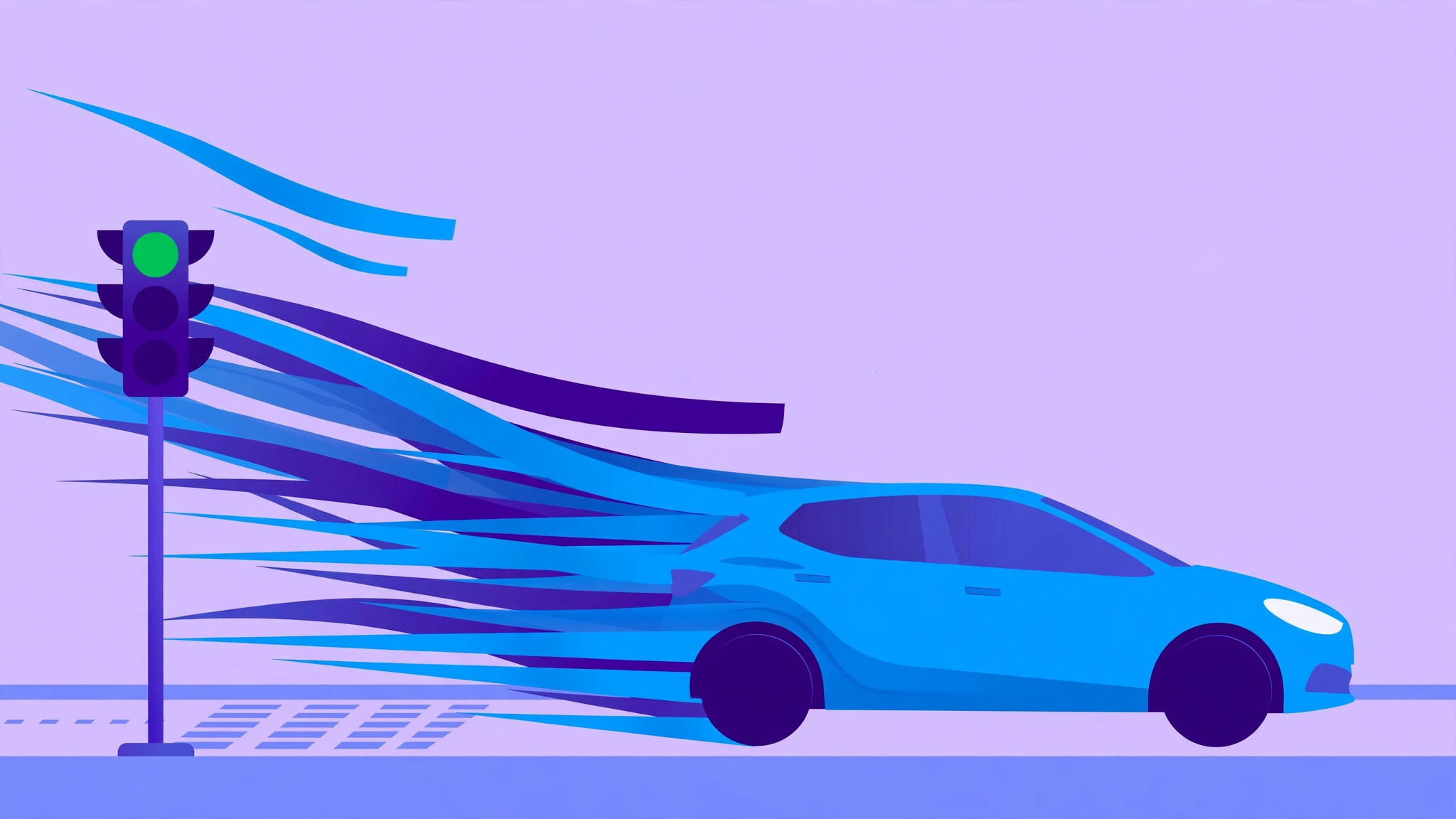
A change, divided by the time it took
Acceleration measures how quickly velocity changes: the change in velocity divided by the time the change took. A car pulling away from lights might gain 20 metres per second in 5 seconds, an acceleration of 4 metres per second squared. The squared second confuses many learners. It simply means the velocity itself, measured per second, grows by that amount every second. After one second the car is 4 metres per second faster, after two seconds 8 faster, and so on while the acceleration lasts. Because velocity has a direction, acceleration does too, and it points in the direction of the change, which is not always the direction of travel.
Slowing down is acceleration too
In everyday speech acceleration means speeding up, but in physics any change of velocity counts, including braking and turning. A braking car has a negative acceleration if forward is positive, often called deceleration in conversation but treated as plain acceleration with a sign in calculations. Turning at a steady speed also accelerates the vehicle, because the direction of its velocity is changing even though the speedometer needle never moves. This is why passengers feel pushed sideways on a roundabout: their bodies are being accelerated toward the centre of the circle. Keeping the physics meaning, change of velocity per second, clears up nearly every puzzle the word causes.
Working it out cleanly
Three habits make acceleration questions routine. First, write down the starting velocity u, the final velocity v and the time t before touching a formula, because most errors come from feeding the wrong number into the right equation. Second, convert everything to metres per second before calculating; a final speed quoted in kilometres per hour is the classic trap. Third, sanity check the size of the answer. Family cars accelerate at roughly 2 to 4 metres per second squared, sports cars near 8, and nothing on a road approaches the 9.81 of free fall for long. The acceleration calculator on this site also returns the distance covered during the change, which is often the figure the question was really hunting.
Try it: Acceleration Calculator
Acceleration is how quickly velocity changes. Give the starting velocity, the final velocity and the time taken, and see the acceleration plus the distance covered on the way.
Open the calculator