Electric Circuits: The Loop and Its Three Quantities
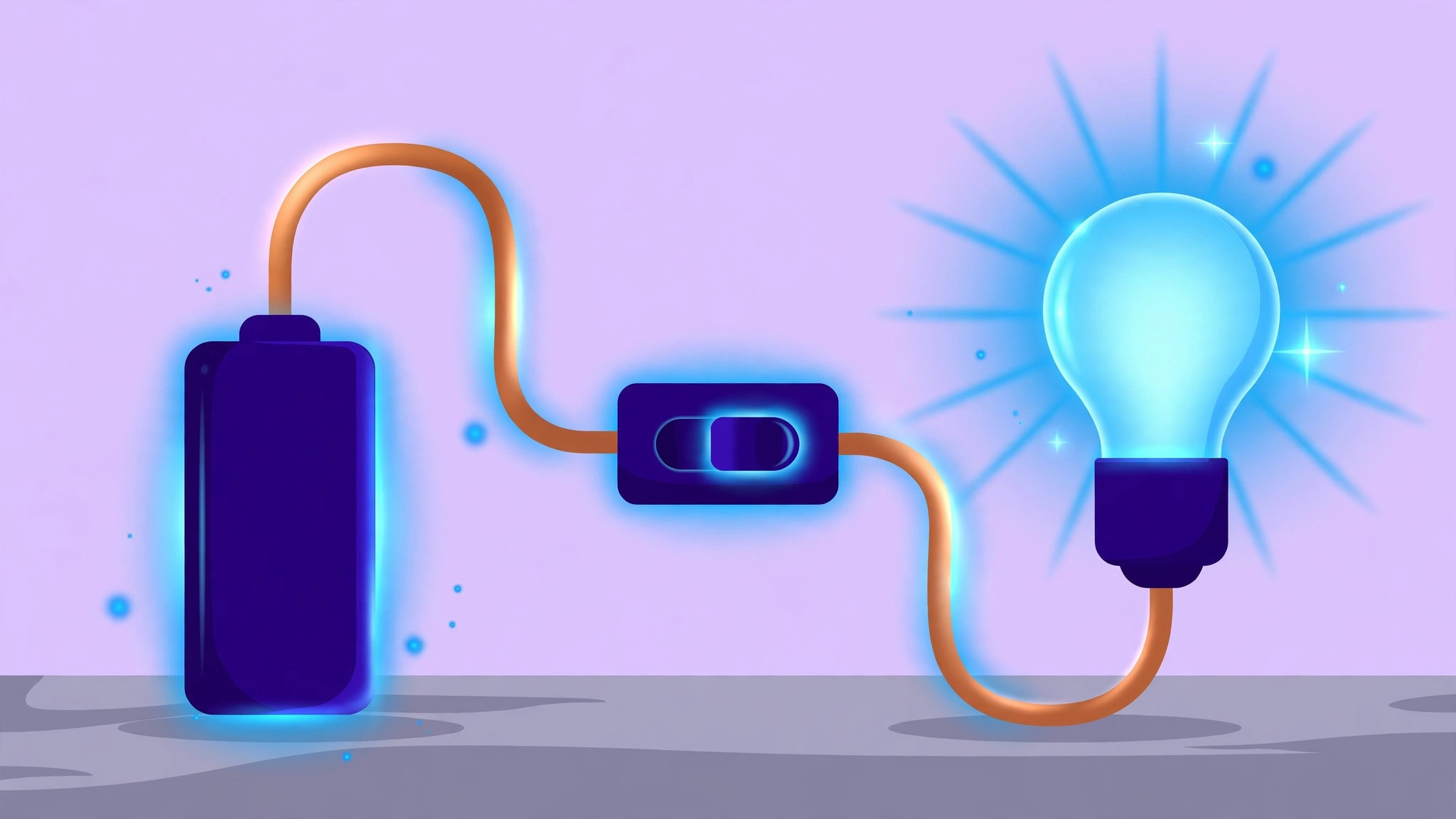
The loop is the law
An electric circuit is a closed loop along which charge can flow. Break the loop anywhere and the flow stops everywhere, which is the whole operating principle of a switch. Inside the loop, three quantities describe everything that matters at this level. Current, in amperes, is the rate of flow of charge: one ampere is one coulomb per second passing a point. Voltage, in volts, is the energy carried per coulomb, the push the source provides and the drop across each component that uses energy. Resistance, in ohms, measures how hard a component makes the flow. A useful picture is water in pipes: voltage as pressure, current as flow rate, resistance as narrowness. The picture misleads in places, current is not used up any more than water is, but as a first map it orients thousands of learners a year.
What the charges actually do
Electrons in a wire drift surprisingly slowly, millimetres per second, yet a lamp lights instantly when the switch closes. The resolution is that the electric field that drives the drift establishes itself through the circuit at nearly the speed of light, setting all the electrons moving at once, like water already filling a hose the moment the tap opens. The energy is carried not by the electrons' slow shuffle but by the field around the wires. In alternating current the electrons merely oscillate in place, fifty or sixty times per second, and energy still flows from station to home. Keeping the drift picture honest prevents a shelf of misconceptions, including the idea that a battery's electrons are consumed. Charge circulates; energy is what gets delivered and used up.
Reading a simple circuit
For a single loop, the rules are two. The current is the same everywhere in the loop, because charge has nowhere to pile up. The voltages around the loop sum to the source voltage, because energy per coulomb gained at the source is spent, exactly, on the way round. Components in the loop share the voltage in proportion to their resistances, which is the seed of the voltage divider, one of the most used arrangements in electronics. With those two rules and Ohm's law, the next guide's subject, a single loop circuit of any number of resistors can be fully solved with arithmetic. Circuits stop being mysterious early; they become bookkeeping, and the books, as with energy, always balance.
Try it: Ohm's Law Calculator
Voltage, current and resistance obey Ohm's law in a simple circuit. Enter any two to find the third.
Open the calculator