Electrical Power: Watts, Bills and Fuses
Watts from volts and amperes
Electrical power is the rate at which a circuit transfers energy, and it is found by multiplying voltage by current: P = V I. A 230 volt appliance drawing 10 amperes is a 2,300 watt device, a serious heater by any standard. Combine the formula with Ohm's law and two more forms appear, P = I squared R and P = V squared over R, each suited to different givens, all three describing the same conversion of electrical energy into heat, light, sound or motion. The electrical power calculator on this site solves for power, voltage or current. Ratings plates on appliances quote the maximum or typical power, which is why a phone charger at 20 watts and a shower at 9,000 watts can share a house without sharing a circuit.
Kilowatt hours: the bill's unit
Energy companies sell energy, not power, and their unit is the kilowatt hour: the energy used when a power of one kilowatt runs for one hour, equal to 3.6 million joules. The distinction between the two quantities is the distinction between a car's speed and its journey distance, and confusing them produces nonsense in both directions. A 100 watt bulb left on for ten hours uses one kilowatt hour, the same as a 1,000 watt heater for one hour. Reading a bill with the power guide's habits, find the rating, multiply by hours, divide by a thousand, and you have the cost driver for every appliance in the house, ranked honestly. Standby loads earn their reputation here: individually small powers, multiplied by every hour of the year, add up to a noticeable slice of many bills.
Fuses: power with a breaking point
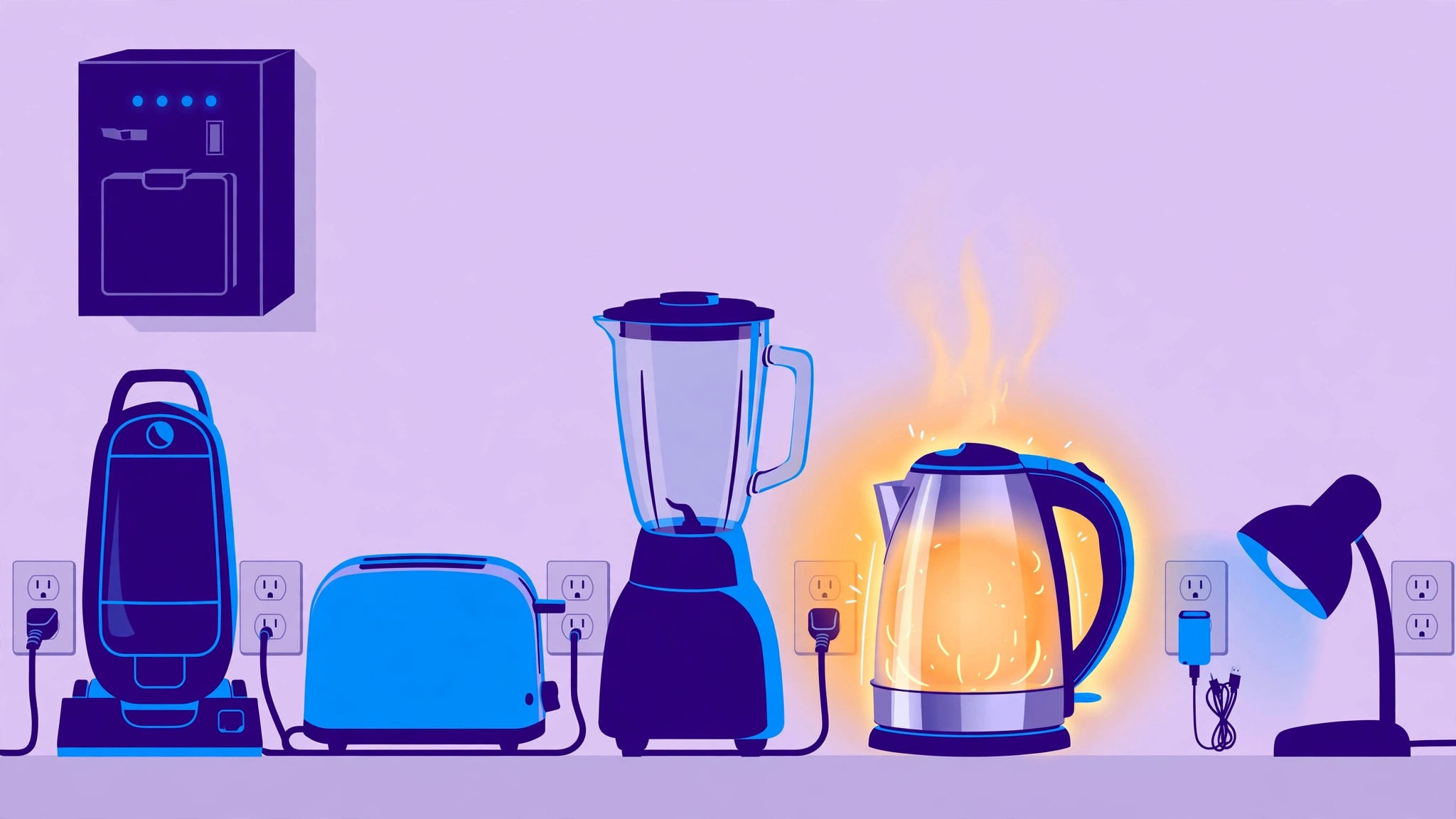
A fuse or circuit breaker guards a circuit against current, and its rating is chosen from the same arithmetic. Too many appliances in parallel draw a total current beyond the cable's safe capacity, the cable heats by I squared R along its whole length, and insulation fails before copper does. The fuse is a calibrated weak link that melts first, cheaply and safely. Choosing one is a power calculation: sum the appliance powers, divide by the supply voltage to get the current, and fit the next standard fuse above it. When a fuse blows repeatedly it is reporting a fact, usually an overloaded circuit or a faulty appliance, and replacing it with a larger one silences the messenger while the message gets hotter. Electricity rewards those who do its arithmetic in advance.
Try it: Electrical Power Calculator
Electrical power is voltage multiplied by current. Enter any two of power, voltage and current to find the third.
Open the calculator