Free Fall: Everything Falls Together
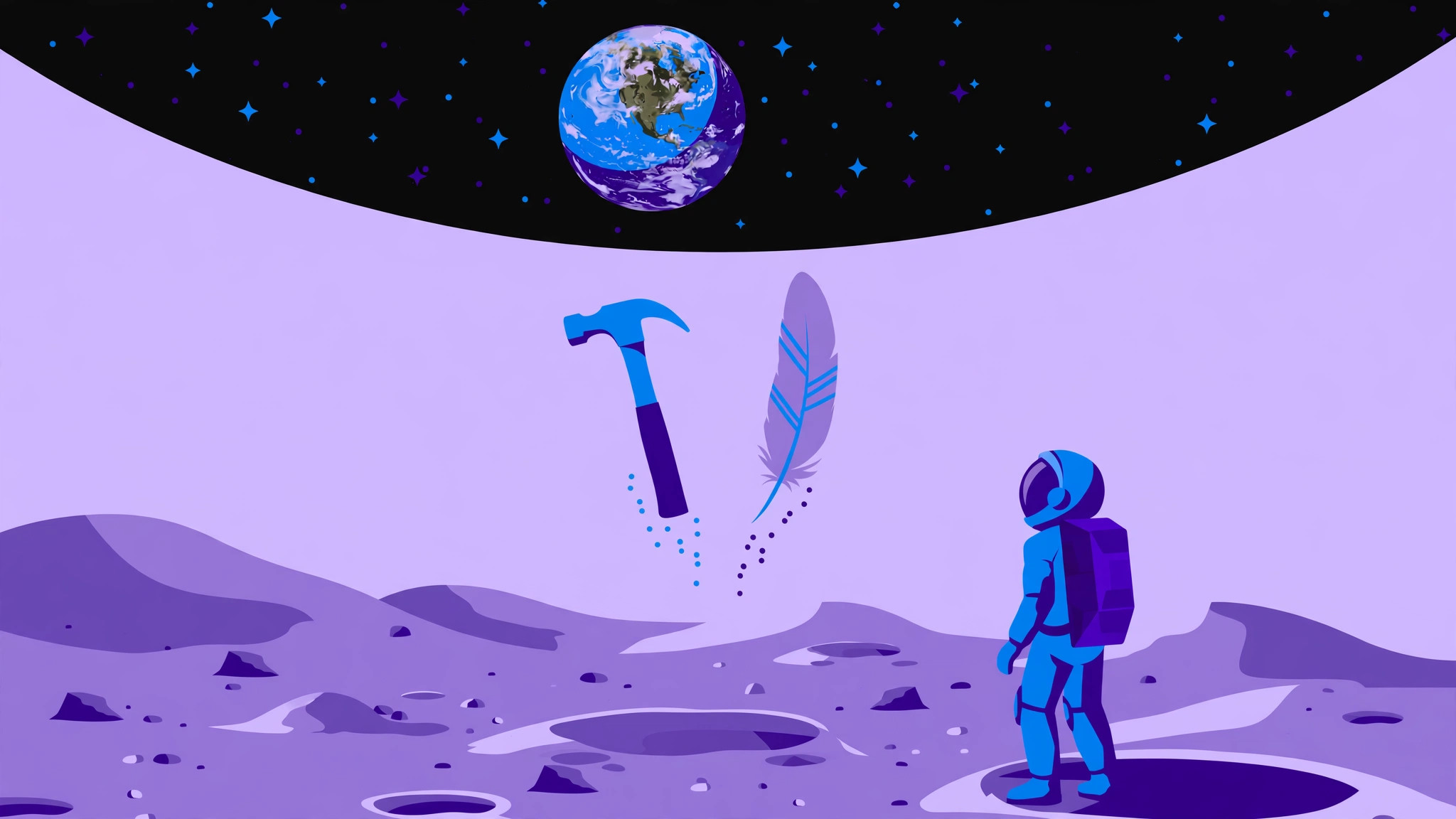
One acceleration for everything
Drop a hammer and a coin together and, air aside, they fall as one. Near Earth's surface the acceleration of free fall is g, about 9.81 metres per second squared, the same for all masses because gravity's force scales with mass exactly as inertia does, as the second law guide explains. The motion is the equations of motion with u often zero and a fixed at g: velocity grows by 9.81 every second, distance grows with the square of time, so an object falls about 5 metres in the first second, 20 by the end of the second, 45 by the third. The free fall calculator on this site gives fall time and impact velocity from any height. Those squares explain why falls from modest heights are survivable and falls from only a few times higher are not: the energy and the impact speed are compounding while the height merely adds.
Air, the spoiler, and a feather on the Moon
In air the tie between hammer and feather breaks because resistance depends on shape and speed, not on mass in the same proportion. A feather's large area and tiny mass let drag match its weight almost immediately, capping its fall at a drift. The definitive demonstration waited for a place without air: on the Moon in 1971, astronaut David Scott dropped a geological hammer and a falcon feather together on live television, and they struck the dust simultaneously, as Galileo had argued they must nearly four centuries earlier. The experiment is worth seeking out, thirty seconds that settle an argument older than the telescope. On Earth, dense and compact objects at modest speeds come close enough to the ideal that free fall calculations predict drop times within a few percent, which is why the model earns its place despite the air in the room.
Falling safely and falling usefully
Free fall arithmetic runs through safety engineering: the distance a falling worker travels before a lanyard arrests the fall, the depth of water a cliff diver needs, the time a dropped tool takes to become dangerous on a building site. It also runs through measurement, since timing a fall over a known height is one of the honest ways to measure g itself. Skydivers complicate the picture deliberately in the next guide, reaching a terminal velocity where drag balances weight. But the baseline is this: unresisted, everything falls together, gaining speed at g, covering ground with t squared. Hold that baseline firmly and every complication, drag, buoyancy, a sloping ramp, presents itself as a correction to a motion you already understand completely.
Try it: Free Fall Calculator
Drop an object from a height and this finds how long it takes to land and how fast it is moving when it does, ignoring air resistance.
Open the calculator