The Inverse Square Law: Geometry With Consequences
Spreading over a sphere
An inverse square law is geometry before it is physics. Anything that streams outward uniformly from a point, light, gravity's influence, an electric field, spreads over the surface of an expanding sphere, and that surface grows with the square of the radius. Double the distance and the same total is painted over four times the area, so the intensity at any point falls to a quarter. Triple it and the share is a ninth. Newton recognised gravity in this pattern, Coulomb found the electric force obeying it independently, and the brightness of stars and the loudness of distant sounds follow it for the same spherical reason. The gravitational force calculator on this site applies the law to two masses; the pattern it encodes is one of the deepest habits of three dimensional space.
What the square does to the solar system
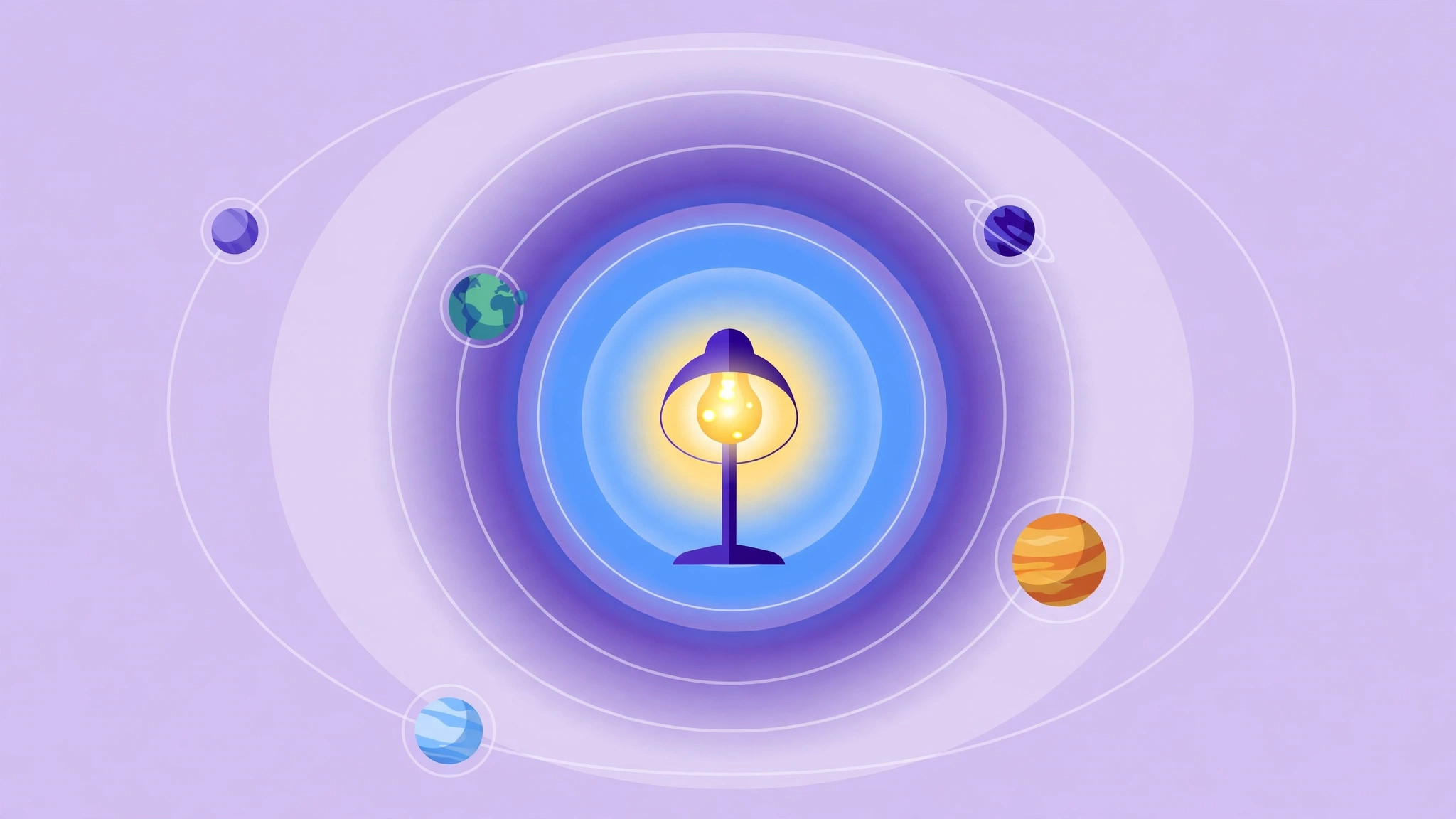
Because gravity weakens with the square of distance, planetary orbits take their characteristic shapes and speeds: close planets whip around quickly under a strong pull, distant ones crawl. The Moon's gravity raises tides on Earth through the law's fine print, since the near side of Earth is pulled measurably harder than the centre and the centre harder than the far side, stretching the oceans into two bulges. Spacecraft navigators live inside the square, computing how a planet's pull fades along a trajectory and using close passes, where the force is fierce, to slingshot probes to the outer planets for free. Even the search for exoplanets reads the law backwards: a star's wobble under a planet's inverse square pull betrays a world too faint to see. One exponent, two, organises the traffic of the entire solar system.
Testing the square
A law this central gets tested this hard. Laboratory measurements with torsion balances confirm the electric inverse square to extraordinary precision, and the gravitational version is checked from millimetre scales in modern experiments to the orbit of the Moon, whose distance is tracked by laser reflectors to centimetres. Any deviation, a slightly different exponent, an extra fall off with distance, would show up in those ledgers and rewrite physics, which is why alternative theories of gravity are constantly measured against the square and constantly, so far, folded back into it. For the student the practical takeaway is simpler: whenever a problem doubles a distance, reach for a factor of four before reaching for a calculator, and whenever a force or brightness refuses to fade that fast, suspect that geometry, not the source, has changed.
Try it: Gravitational Force Calculator
Every mass attracts every other mass. Newton's law of universal gravitation gives the force between two masses separated by a distance.
Open the calculator