Impulse and Crumple Zones: Buying Time in a Crash
The same change, spread out or squeezed
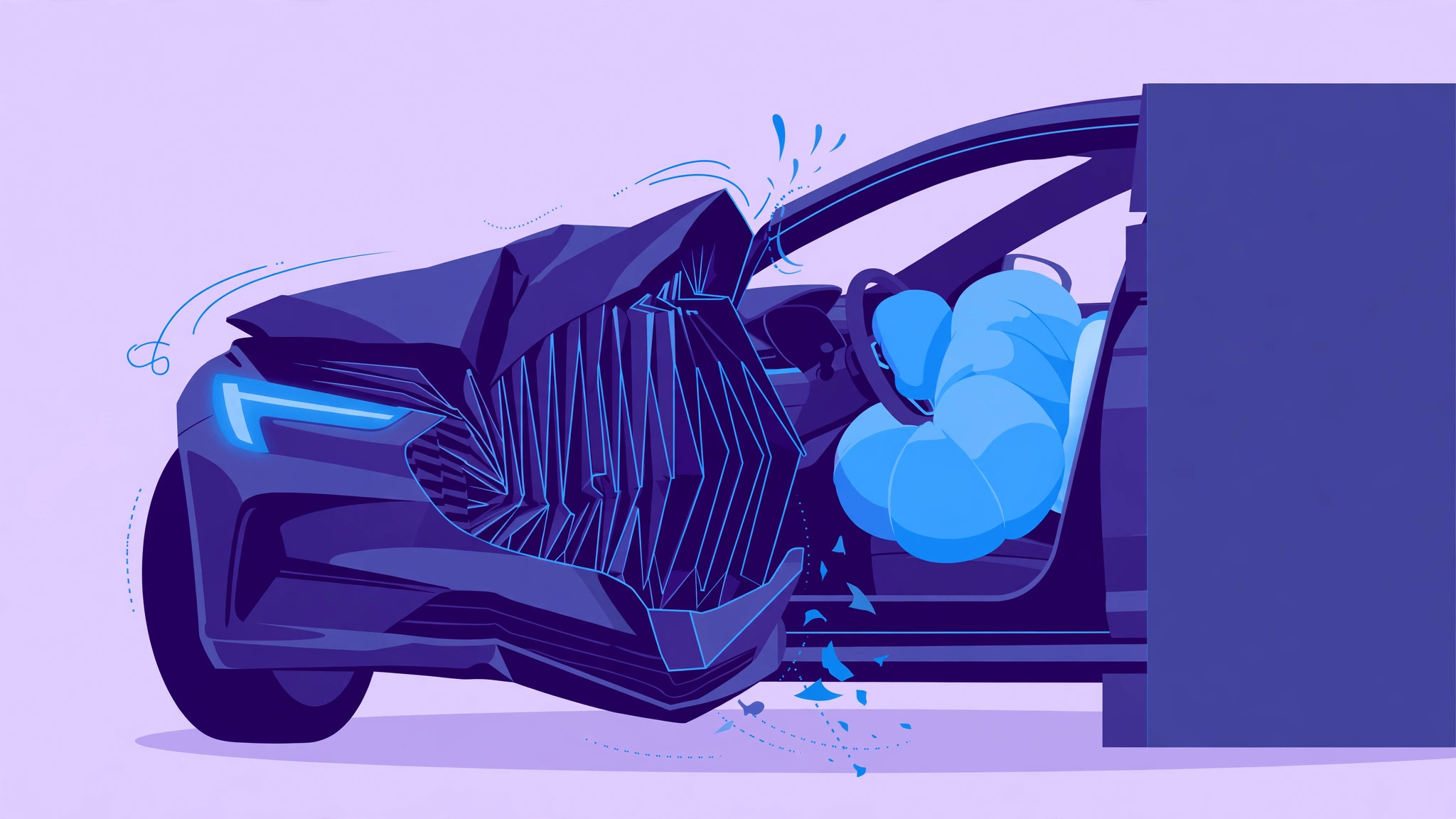
Impulse is force multiplied by the time it acts, and it equals the change in momentum it produces. A passenger in a car that stops suddenly must lose a fixed amount of momentum: their mass times their speed. That total cannot be negotiated. What can be negotiated, enormously, is the time over which the loss happens, and therefore the force. Stop in a twentieth of a second against a dashboard and the force is twenty times larger than stopping over a full second. Every safety device in a vehicle is a time-stretching machine. Crumple zones fold progressively so the passenger compartment decelerates over a longer distance and time. Airbags spread the stop over a cushion instead of a steering wheel. Seatbelt webbing stretches a little, on purpose.
Catching, jumping and following through
The same principle runs through sport, in both directions. A fielder catching a fast ball pulls their hands backwards with the catch, stretching the stopping time and sparing their palms. Landing from a jump with bent knees turns a jarring stop into a managed one, which is why parachutists roll. In the opposite direction, generating impulse is how athletes hit hard: a boxer, golfer or tennis player maximises force and keeps it applied through the longest contact they can manage, following through so the force acts for more milliseconds on the ball. The impulse calculator on this site multiplies force by time and, if you add the mass, shows the velocity change that impulse buys. Small times are the whole story: doubling contact time doubles the effect at the same force.
Reading accident reports with impulse eyes
Once you see collisions as momentum changes delivered over times, news reports read differently. Helmets work because the foam crushes over milliseconds that a bare skull does not have. Packaging protects electronics the same way, with foam that trades a longer, gentler stop for a shorter, harder one. Even the design of a boxing glove, a gymnastics mat and a car's front end reduces to one question: over what time shall this momentum change be spread? There is a limit, set by how much crush space exists, which is why speed matters so brutally: double the speed doubles the momentum to shed, and kinetic energy, the other bill to pay, quadruples. Impulse thinking does not repeal those numbers, but it explains every device humans have built to live with them.
Try it: Impulse Calculator
Impulse is force applied over time, and it equals the change in momentum. Add a mass as well and the change in velocity appears.
Open the calculator