Kinetic Energy: Why the Square of Speed Rules
Half m v squared, and the square is the story
Kinetic energy is the energy an object has because it moves: one half of its mass multiplied by the square of its speed. The mass part behaves as intuition expects, doubling the mass doubles the energy. The squared speed does not. Double the speed and the energy quadruples; triple it and the energy is nine times as large. This single mathematical fact explains a startling amount of the physical world, from why motorway crashes are so much more destructive than town crashes to why spacecraft need such enormous rockets. Any time a question involves stopping, hitting or heating something that moves, the square is silently setting the scale of the answer, and intuition trained on straight proportions will underestimate it every time.
Stopping distances and the tyranny of the square
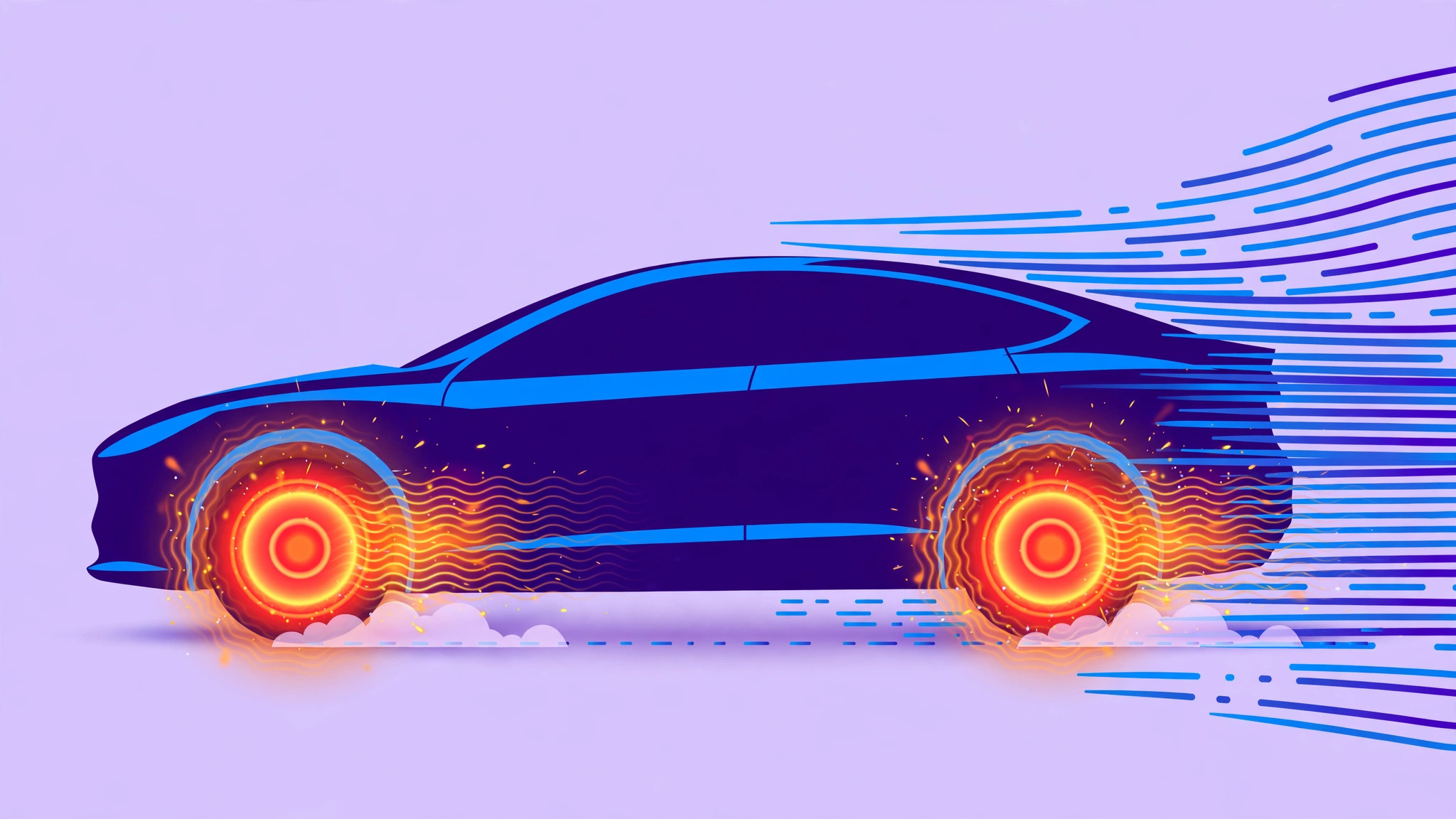
A car's brakes must convert all of its kinetic energy into heat. At 30 miles per hour a typical car carries a certain energy; at 60 it carries four times as much, so the braking distance, once the driver has reacted, stretches roughly fourfold too. Official stopping distance charts show exactly this curve, with the braking portion growing quadratically while the thinking distance grows only in proportion to speed. The same square governs what a falling object can do on arrival, why a cricket ball at professional pace carries dangerous energy despite its modest mass, and why meteor impacts release energy so wildly out of proportion to the size of the rock. The kinetic energy calculator on this site solves for energy, mass or speed, and sliding the speed up in small steps is the fastest way to develop respect for the square.
Where the energy goes
Kinetic energy rarely disappears; it converts. Brakes turn it into heat, which is why racing brakes glow. A ball bouncing converts some into sound, heat and deformation at each bounce, which is why the bounces die away. Regenerative braking in electric vehicles runs the conversion backwards into a battery, recovering a useful share. In collisions the energy goes into bending and breaking, and the amount available to bend and break is set by the square of the closing speed. Engineers designing crumple zones, catch fences, playground surfaces and packaging are all, in the end, arranging destinations for kinetic energy and trying to give it somewhere harmless to go.
Try it: Kinetic Energy Calculator
Kinetic energy is the energy of motion. Enter any two of energy, mass and speed to find the third. Doubling speed quadruples the energy.
Open the calculator