Lenses and Mirrors: Images From Bent Light
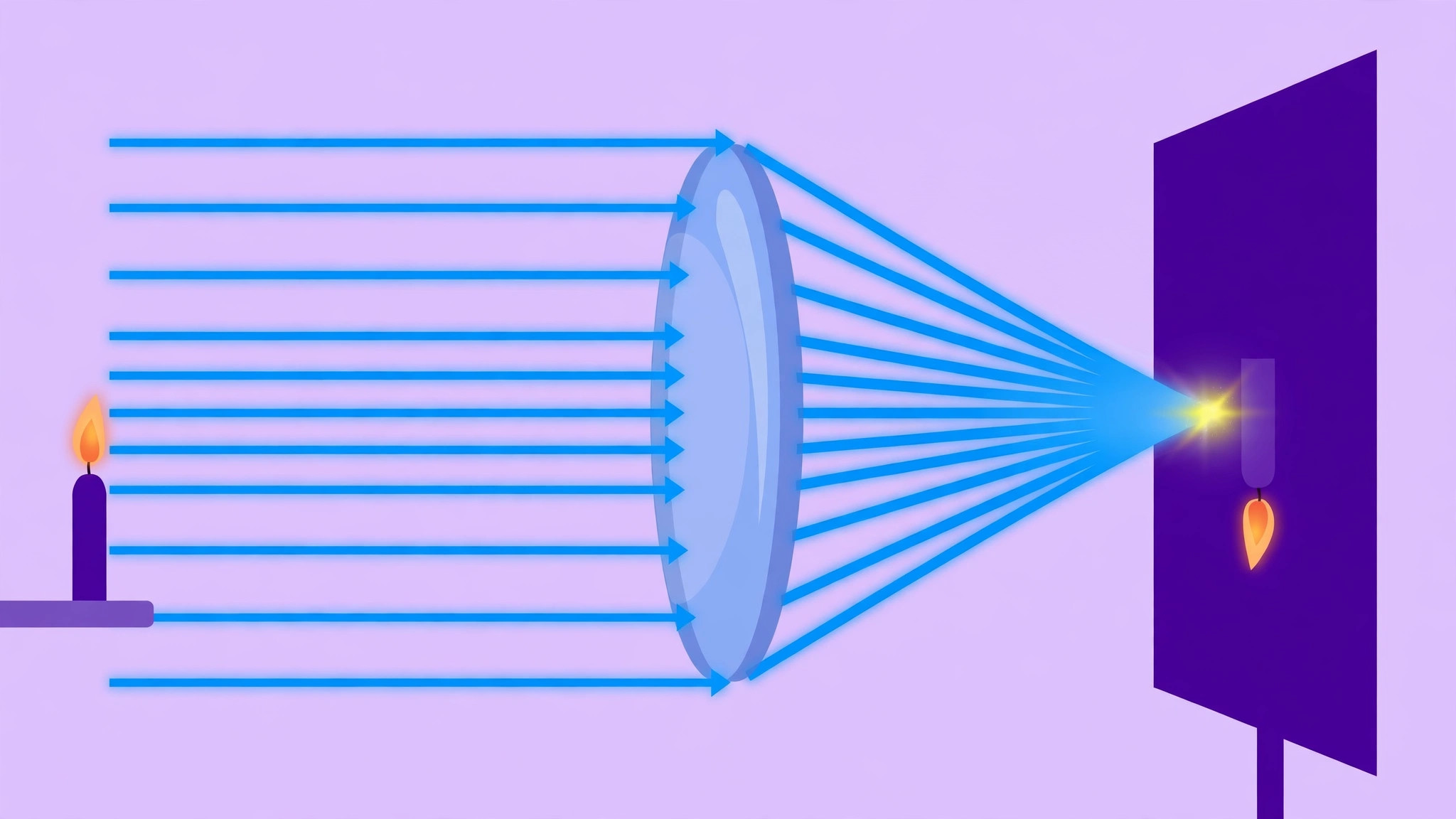
Bringing light to a point
A converging lens is thicker in the middle and bends parallel rays inward until they meet at the focal point; a concave mirror does the same by reflection. The distance from lens or mirror to that point is the focal length, and its reciprocal, in metres, is the power in dioptres that opticians prescribe. The thin lens equation connects the three distances that matter: one over focal length equals one over object distance plus one over image distance. It predicts where an image forms for any arrangement, which is the whole design problem of cameras, projectors, telescopes and eyes in one line of algebra. The lens equation calculator on this site solves for any of the three distances and adds the magnification, the ratio that says how large and whether upright or inverted.
Real, virtual, magnified, diminished
Images come in two kinds. A real image forms where rays actually meet, and can be caught on a screen: cinema projectors and cameras make real images, upside down. A virtual image forms where the backward extensions of rays meet, visible by eye but impossible to project: the magnified face in a shaving mirror and the view through a magnifying glass are virtual and upright. Magnification, image distance over object distance with a sign that flags inversion, tells the size story. Move an object closer to a converging lens and the image retreats and grows, until the object crosses inside the focal length and the image flips virtual, the magnifier regime. Every optical instrument is a choreography of these moves, and the sign conventions, fiddly as they seem, exist to make one equation describe all of it.
Eyes, glasses and honest limits
The eye is a converging system of about 60 dioptres total power, most of it at the cornea's surface where air meets tissue and the speed of light changes most, with the lens fine tuning focus by changing shape. Short sight and long sight are focal length mismatches between the eye's optics and its length, corrected by adding or subtracting dioptres with glasses. Real lenses suffer aberrations the thin lens equation ignores: colours focus at slightly different points because refractive index varies with wavelength, and rays at the edge focus differently from rays at the centre. Achromatic doublets, aspheric shapes and multi element designs are centuries of engineering against those two facts. The equation in this guide is the ideal; the instruments in your pocket are the ideal plus a hundred corrections, which is a fair summary of applied physics generally.
Try it: Lens and Mirror Equation Calculator
The thin lens equation links focal length, object distance and image distance for lenses and mirrors. Enter any two and find the third, with the magnification.
Open the calculator