Magnetism Basics: Poles, Fields and Moving Charge
Poles, fields and no monopoles
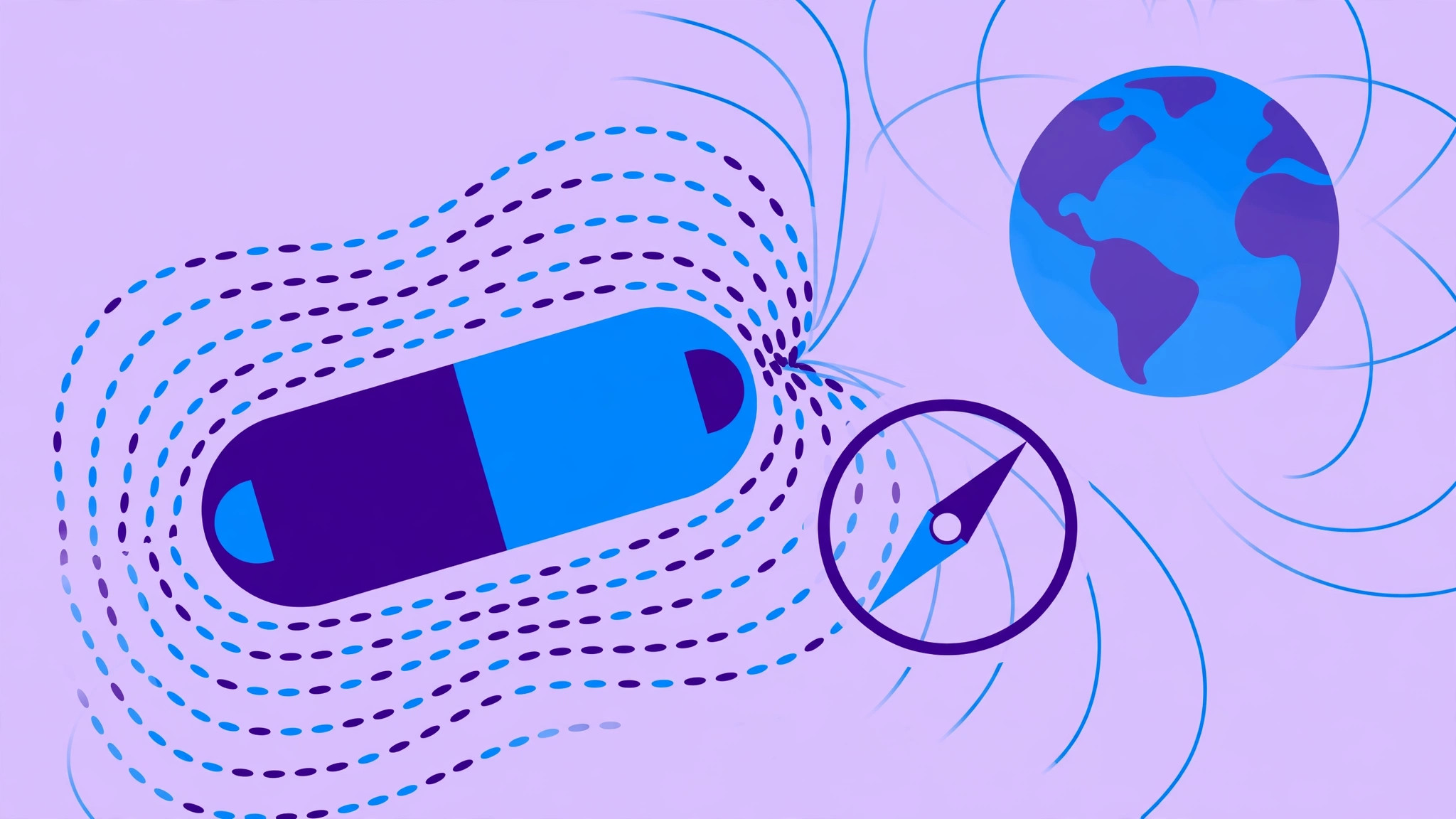
Every magnet has two poles, north and south, and the first surprise of the subject is that they cannot be separated: cut a magnet in half and each half is a complete magnet with both poles, down to the smallest piece physics has tested. Like poles repel, unlike poles attract, and around every magnet lies a field, mapped by iron filings into lines that leave the north pole and enter the south. Compasses work because Earth itself is a magnet of planetary size, its field generated by churning molten iron in the core, with magnetic poles that wander measurably over the years and sit, at present, some distance from the geographic poles. The field is weak, about a twentieth of a fridge magnet's surface strength, yet it steers migrating birds, shields the surface from much of the solar wind, and paints the auroras where that wind breaks through near the poles.
Magnetism is electricity in motion
The deep fact of the subject is that magnetism is not a separate force of nature bolted onto electricity. A current in a wire produces a magnetic field circling the wire, the discovery that launched electromagnetism in 1820 when Hans Christian Oersted watched a compass needle twitch beside a live wire. Wrap the wire into a coil and the fields add into an electromagnet, a magnet you can switch, strengthen and reverse at will, which lifts scrap cars, holds fire doors and drives every electric motor's first push. Conversely, moving a magnet near a coil induces a current, the generator effect on which the entire power grid rests. Electricity and magnetism are two views of one phenomenon, fully unified in the nineteenth century and expressed in the equations that also predicted light's speed from laboratory measurements of charges and magnets.
Where this guide stops, honestly
School physics treats magnetism mostly through its effects: forces on currents and moving charges, motors, generators and transformers, all real and all testable. The full theory, in which the magnetic force appears as a relativistic consequence of electric forces and the length contraction of moving charges, belongs to a later stage and is one of physics' great plot twists. What can be said here without overreach is that nothing in the everyday subject is arbitrary: the motor spins and the generator generates for the same underlying reason, stated in the field language the electric field guide introduced. A magnet is never magic. It is charge, organised and moving, all the way down to the spin of the electrons inside its atoms, which is as good a place as any to feel the subject's depth.