Mass vs Weight: The Difference That Matters
Two ideas wearing one word
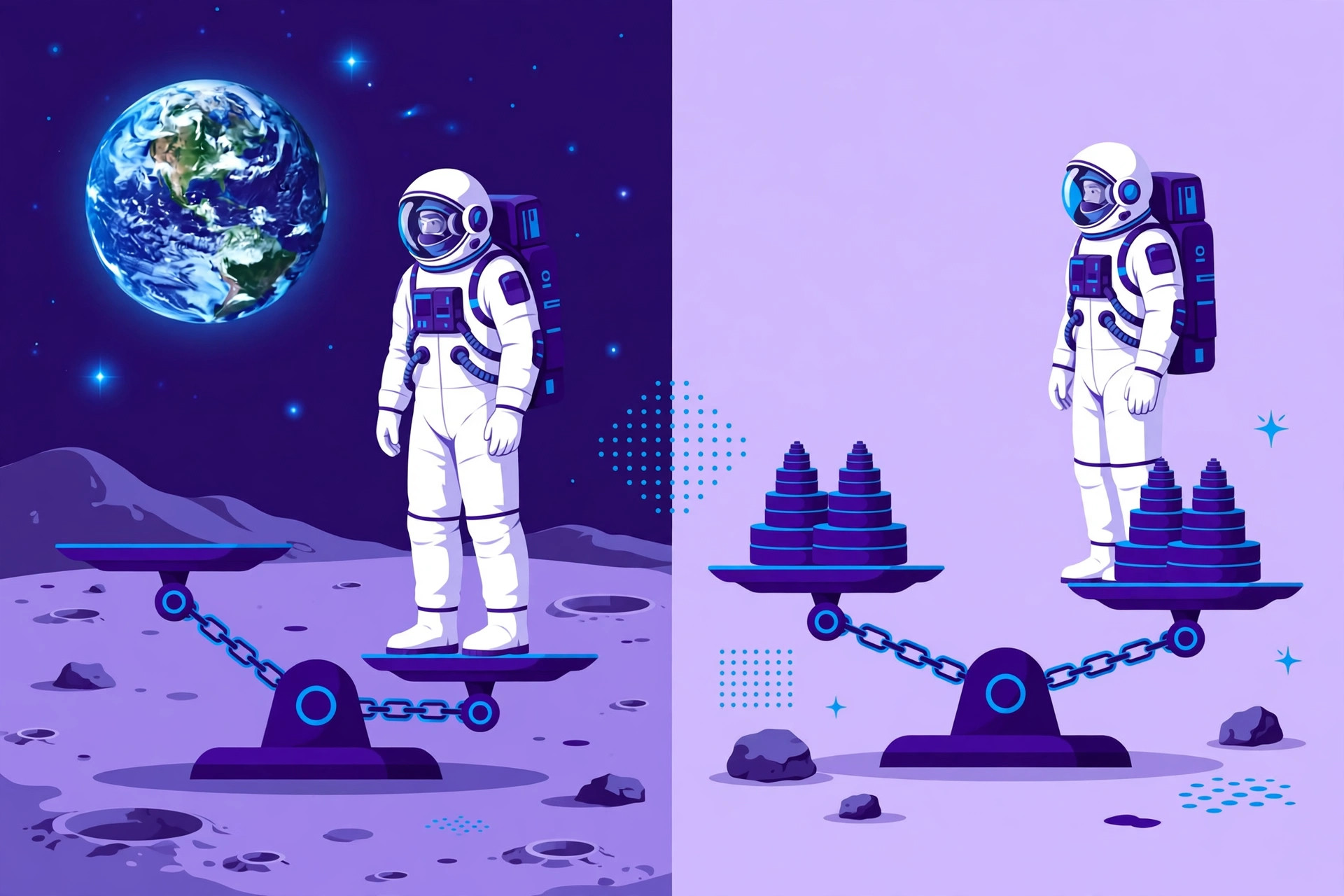
Everyday language uses weight for what physics splits in two. Mass measures how much matter an object contains and, just as importantly, how strongly it resists being accelerated. It is measured in kilograms and it does not change when you travel: the same astronaut has the same mass on Earth, on the Moon and in deep space. Weight is a force, the pull of gravity on that mass, measured in newtons, and it changes with the local gravity. When a bathroom scale reports kilograms it is really measuring a force and quietly assuming Earth's gravity to convert it back into mass. On the Moon the same scale would report a sixth of your mass, not because you shrank, but because the scale's hidden assumption failed.
Measuring each one properly
A balance compares masses: put the object on one side and known masses on the other, and gravity pulls both sides equally, so the balance reads true mass anywhere in the universe. A spring scale or a bathroom scale measures force, and must be calibrated for the gravity where it is used. This is why scientists are stubborn about the distinction even though shopkeepers survive without it. In calculations the difference is mechanical: mass enters Newton's second law as the thing being accelerated, while weight enters as one of the forces doing the accelerating, W = m g. Confusing them mid problem is the single most common source of answers that are wrong by a factor of 9.81, a number examiners recognise on sight.
Why the distinction earns its keep
The difference stops being academic the moment gravity changes. Engineers designing a lunar lander care about its mass for every acceleration and burn, and about its weight, a sixth of Earth's, for the strength of its landing legs. A crane rated by the mass it can lift on Earth would lift six times the mass on the Moon but the load would be just as hard to swing sideways, because inertia follows mass, not weight. The weight calculator on this site takes a mass and a gravity and returns the force, with the Moon and Mars alongside for comparison. Keep the sentence handy: mass is yours, weight is yours times a place, and physics keeps the two in separate columns because nature does.
Try it: Weight Calculator
Weight is the force of gravity on a mass. Enter the mass and the local gravity (9.81 m/s^2 on Earth's surface) to find the weight in newtons.
Open the calculator