Ohm's Law Explained: Push, Flow and Resistance
A relationship, not a commandment
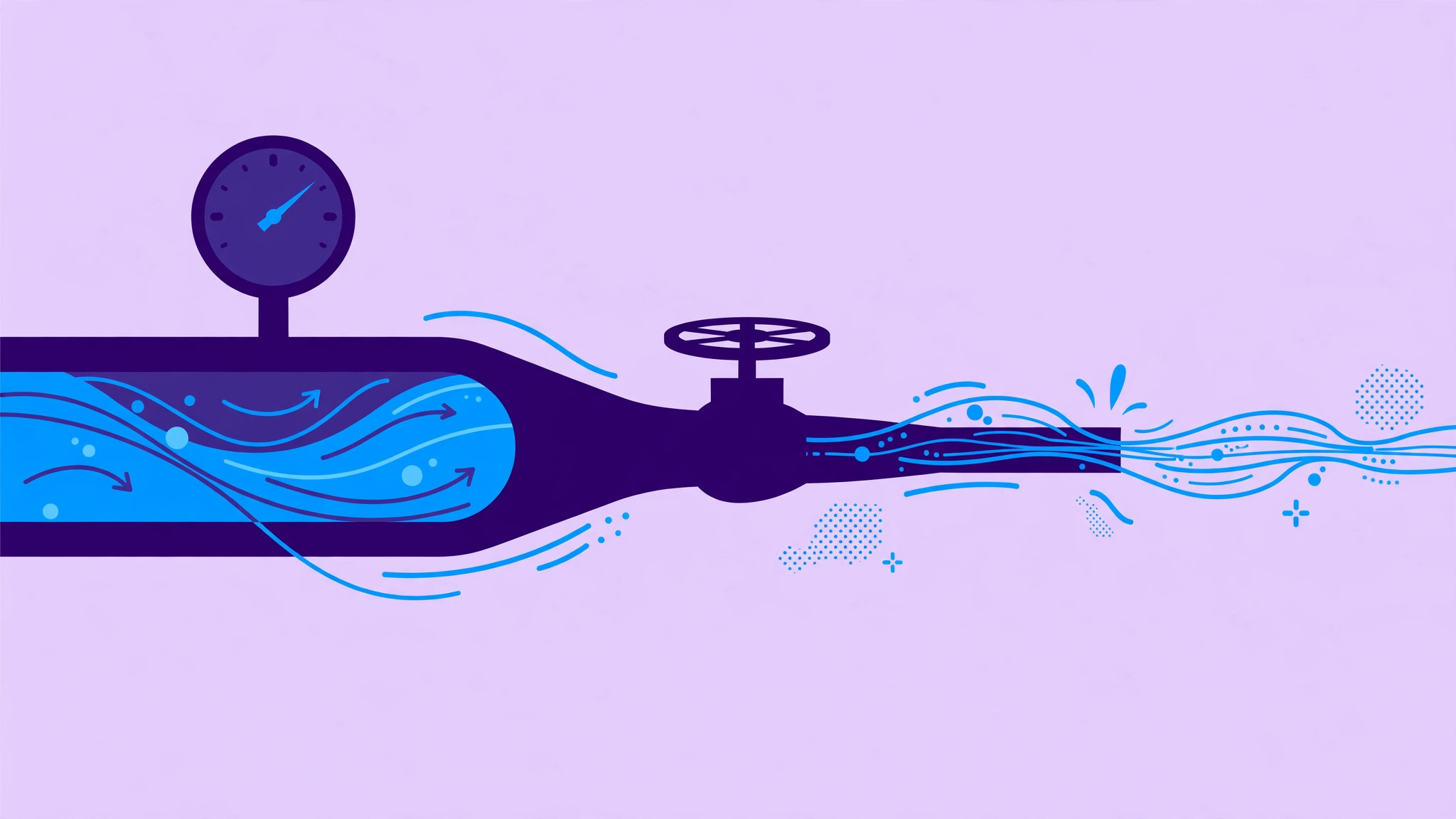
Ohm's law states that for many conductors at steady temperature, the current through them is proportional to the voltage across them, and the constant of proportionality is the resistance: V = I R. It is an empirical regularity, not a fundamental law like conservation of energy, and materials that obey it are called ohmic. A metal wire at constant temperature obeys it beautifully. Heat the wire and its resistance climbs, bending the relationship. A diode ignores it entirely, conducting one way only and with a threshold. Knowing the law's limits is part of knowing the law: apply it to resistors, lamps at a working point and household circuits with confidence, and treat it as an approximation anywhere temperature swings widely or electronics get clever.
Three forms, one triangle
The law rearranges into three forms: V = I R to find voltage, I = V / R to find current, R = V / I to find resistance. The Ohm's law calculator on this site solves for whichever you need. The physics inside the rearrangements is worth a look. Doubling the voltage on a fixed resistance doubles the current, because twice the push drives twice the flow through the same narrowness. Doubling the resistance at fixed voltage halves the current. Household wiring runs on the second form: a 12 volt car battery across a 4 ohm headlamp drives 3 amperes, and across a faulty 1 ohm short it would try to drive 12, which is what fuses exist to interrupt. Most circuit questions in school and in life are one of these three divisions wearing a story.
Resistance in the real world
Resistance has a geography: it grows with the length of a conductor, shrinks with its cross-sectional area, and depends on the material through resistivity, a property ranging from copper's low value to rubber's astronomical one. That geography explains thick cables for high currents, since area is the cheap way to cut resistance and the heating it causes. Heating is the tax resistance collects: electrical energy converts to heat at a rate of I squared R, welcome in a kettle and a fire risk in an overloaded extension lead. Superconductors escape the tax entirely below their critical temperatures, carrying currents with zero resistance, which is why they coil the magnets of hospital scanners. Ohm's law, a schoolroom formula, turns out to be the entry point to power engineering, materials science and a good fraction of electrical safety law.
Try it: Ohm's Law Calculator
Voltage, current and resistance obey Ohm's law in a simple circuit. Enter any two to find the third.
Open the calculator