Pendulum Motion: Time Kept by a String
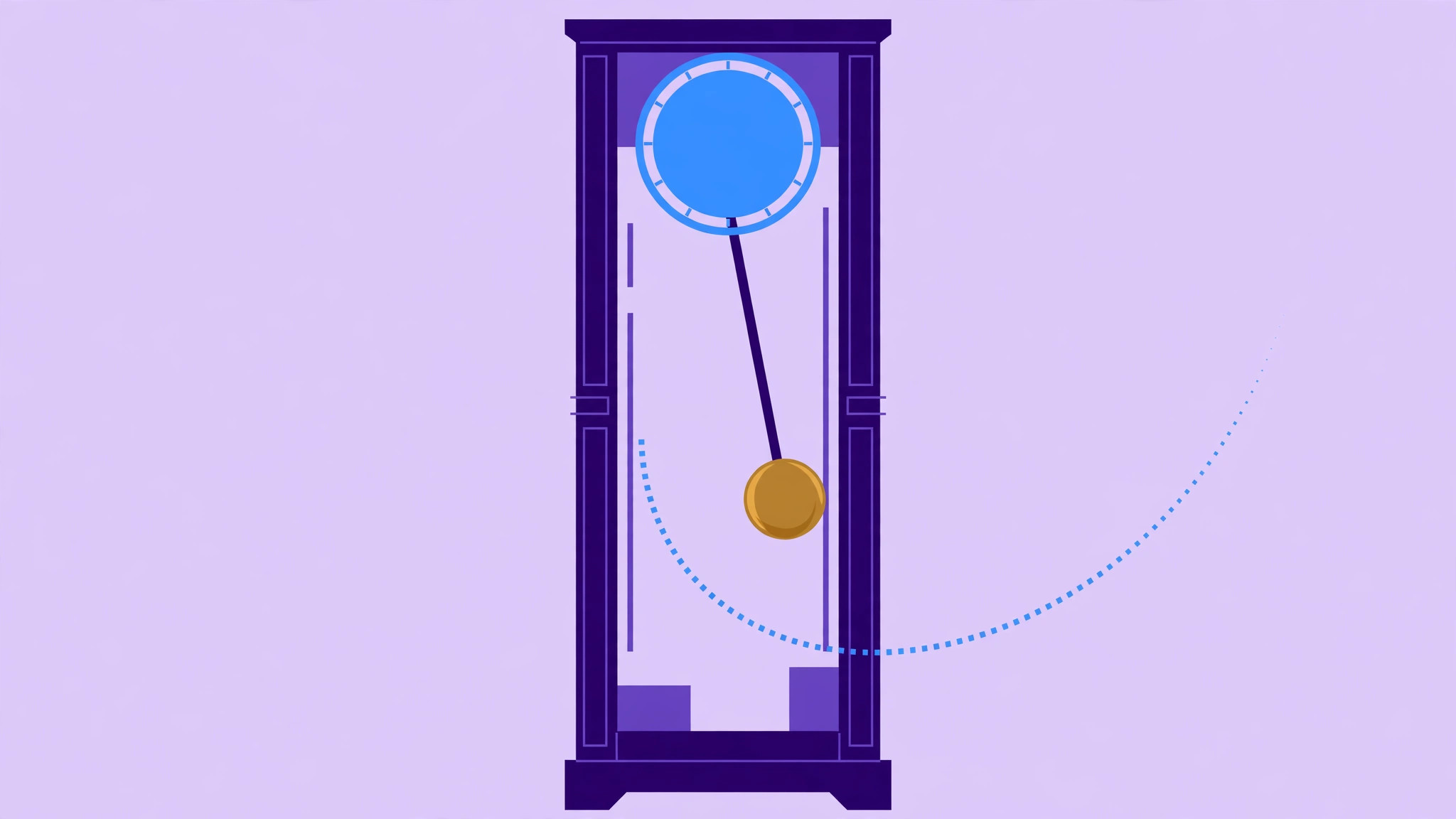
The swing that ignores the bob
A simple pendulum, a mass on a string swinging through small angles, keeps a period set by a surprisingly short list of ingredients: its length and the local gravity. The mass of the bob does not matter. The size of the swing, within small angles, barely matters. Double the length and the period grows by the square root of two, not by two; quadruple the length and the period exactly doubles. The formula, T = 2 pi sqrt(L / g), made the pendulum the first precision timekeeper in history. A pendulum about a metre long has a period of almost exactly two seconds, one second each way, which is why grandfather clocks are the size they are: the case is built around the physics.
Galileo, Huygens and the clock that changed maps
Legend has Galileo timing a swinging cathedral lamp with his pulse and noticing the period stayed constant as the swing died down. Whether or not the lamp is history, the insight became technology when Christiaan Huygens built the first pendulum clock in 1656, improving timekeeping from losing minutes a day to losing seconds. Accurate clocks at sea meant longitude could be calculated, which redrew navigation. The pendulum calculator on this site returns period and frequency from length and gravity. Run it for the Moon's gravity and the same clock ticks forty percent slower, which is why a pendulum clock carried to another planet becomes a gravity meter in disguise: time the swing, and g falls out of the formula.
Measuring g with string and patience
The pendulum is the classic school experiment for measuring the acceleration of gravity: measure the length carefully, time fifty swings to shrink the reaction time error, divide, and rearrange the formula to get g. The pitfalls are instructive. Timing too few swings lets human reaction dominate; swinging too wide breaks the small angle approximation and lengthens the period slightly; measuring to the top of the bob instead of its centre shortens the length. Each is a small lesson in experimental design. The same mathematics governs a child's swing, which is a pendulum you sit on: pumping works by changing your effective length at the right moments, feeding energy in rhythm with the period the formula predicts.
Try it: Pendulum Period Calculator
A simple pendulum's swing depends on its length and on gravity, not on its mass. Find the period and frequency of the swing.
Open the calculator