Photon Energy: Light in Packets
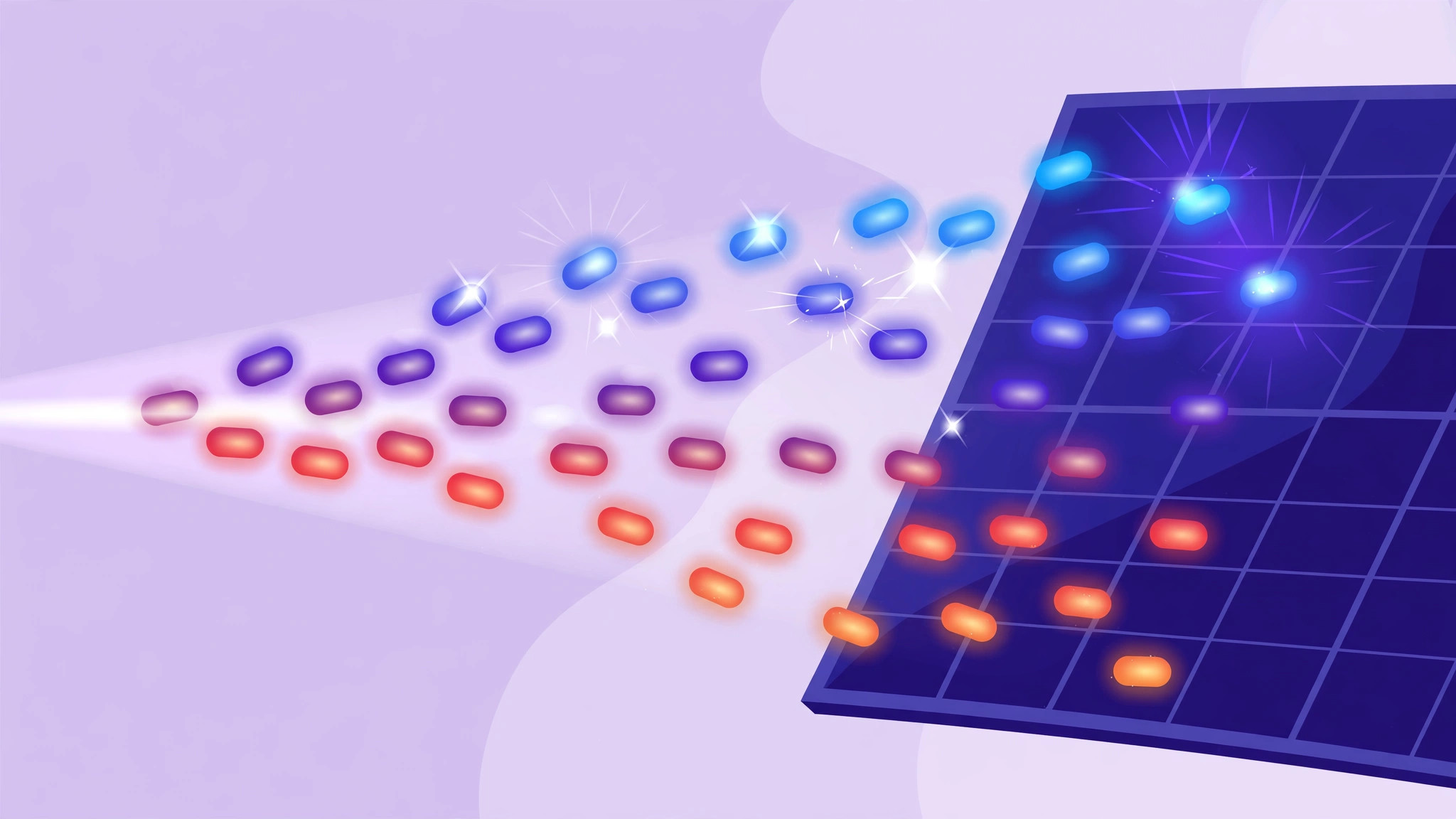
Light, counted in packets
At the start of the twentieth century physics was forced to a strange conclusion: light, demonstrably a wave, exchanges energy in discrete packets called photons, each carrying energy E = h f, where f is the frequency and h is Planck's constant, 6.626 x 10^-34 joule seconds, a number so small that a single photon of visible light carries only a few times 10^-19 joules. The photon energy calculator on this site converts any frequency into joules and into electronvolts, the unit working physicists prefer at this scale, and also returns the wavelength. A green photon near 5.6 x 10^14 hertz carries about 2.3 electronvolts. Individually negligible, photons arrive in floods: a modest lamp emits on the order of 10^20 per second, which is why the graininess of light hides from everyday notice.
Why frequency, not brightness, draws the lines
The photoelectric effect made the packet idea unavoidable: light shining on metal ejects electrons only if its frequency passes a threshold, however bright the light, while brighter light below the threshold ejects none at all. Energy per photon, set by frequency, decides what a single photon can do; intensity merely counts photons. This one fact organises a continent of phenomena. Ultraviolet photons carry enough energy each to break chemical bonds in skin, which red light cannot do at any brightness, so sunburn is a frequency injury. Solar cells have a threshold set by their material: photons below it pass through unused, photons above it waste their excess as heat, and that double loss caps the efficiency of a single junction cell near a third, a limit engineers route around with stacked materials tuned to different colours.
Photons at work
Once energy per photon is a design variable, technology follows. Lasers concentrate photons of one frequency into a beam whose every packet can be aimed at the same atomic transition. LEDs are chosen by the photon energy their semiconductor gap produces, blue being the hard won high energy prize that completed white light. X-ray photons, thousands of times more energetic than visible ones, pass through soft tissue and stop in bone, which is both their diagnostic gift and their hazard. Astronomy reads the universe by photon energy: radio photons whisper from cold gas, visible photons from stars' surfaces, gamma rays from the most violent events known. The equation E = h f is one multiplication; the sciences built on it fill a library, and the constant h, measured ever more precisely, now helps define the kilogram itself.
Try it: Photon Energy Calculator
Light arrives in photons, each carrying energy set by its frequency. Planck's constant turns a frequency into an energy, shown in joules and electronvolts.
Open the calculator