Pressure in Fluids: Deeper, Stronger, Everywhere
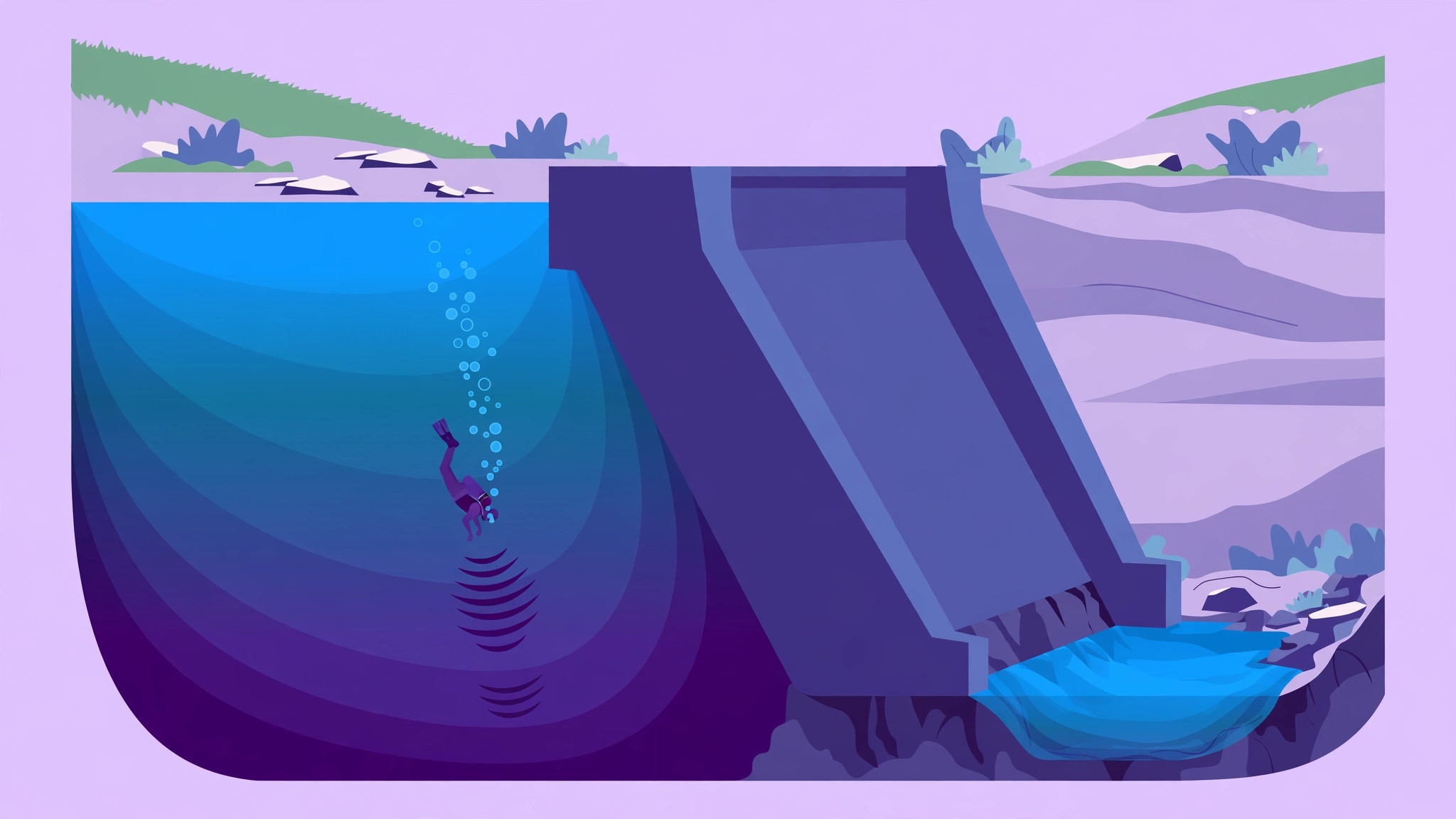
Deeper means heavier above you
Stand in a swimming pool and the water squeezes you with a pressure that grows as you descend, because each layer of water carries the weight of all the water above it. The formula is compact: pressure equals density times gravity times depth. For water, every ten metres of depth adds about one atmosphere of pressure, which divers plan their lives around. Two consequences surprise beginners. The pressure at a given depth is the same in all directions, pushing up and sideways as hard as it pushes down. And it depends only on depth, not on the shape or total volume of the container: a narrow tube and a wide lake at the same depth produce the same pressure at the bottom, a fact called the hydrostatic paradox that once convinced sceptics with a bursting barrel and a long thin pipe.
Dams, ears and barometers
Dam walls are built thicker at the base because that is where the pressure, and therefore the sideways force, is greatest; the profile of a dam is a drawing of the pressure formula. Your ears pop in a descending aircraft and ache underwater because pressure differences across the eardrum are exactly what the formula predicts, and equalising them is a practical physics skill. A barometer turns the formula into an instrument: the atmosphere pressing on a reservoir holds up a column of mercury about 760 millimetres high, and the column's height reports the air pressure that the liquid pressure calculator adds on top of the water's own contribution. Suction, often spoken of as a pulling force, is really the higher pressure on the other side pushing; a straw works because the atmosphere shoves the drink up toward your lower pressure mouth.
Hydraulics: pressure as a messenger
Liquids are nearly incompressible, so pressure applied to an enclosed liquid is transmitted undiminished to every part of it, Pascal's principle. A hydraulic jack exploits this with two pistons of different areas: a small force on the small piston creates a pressure that acts on the large piston's greater area to produce a large force, lifting a car with a hand lever. The trade is distance, as always: the small piston travels far so the large one can rise a little, and the work balances. Brakes, diggers, aircraft controls and dentist's chairs all run on this messenger service. The liquid pressure calculator on this site gives the extra pressure at any depth in any liquid, with the total including atmospheric pressure, which is the figure a diver's body actually experiences.
Try it: Liquid Pressure Calculator
Pressure in a liquid grows with depth. Enter the liquid's density and the depth to find the extra pressure at that depth, with the total including air pressure on top.
Open the calculator