Sound Waves: Squeezed Air You Can Hear
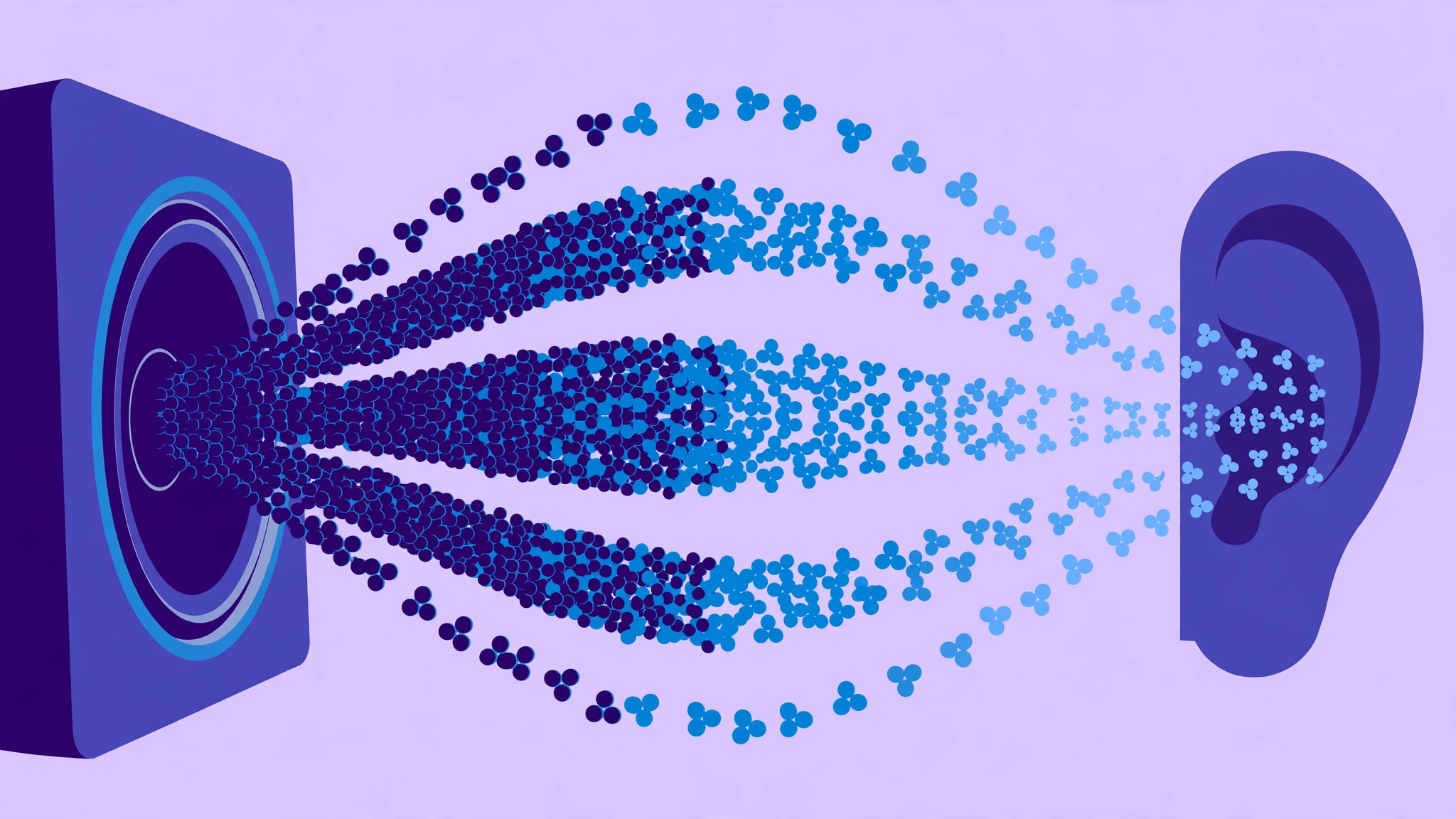
A vibration that the air passes on
Sound begins with something vibrating: a string, a reed, a speaker cone, your vocal cords. The vibration pushes air molecules into regions of compression, where they crowd together, followed by regions of rarefaction, where they thin out. Each layer of air shoves the next and falls back, so a pattern of squeezes and stretches marches outward while the air itself stays, on average, where it was. That makes sound a longitudinal wave, oscillating along its direction of travel. It also means sound needs a material to travel through. In the vacuum of space there is nothing to squeeze, and explosions, whatever films suggest, are silent. Astronauts on the Moon speak by radio, which is light, not sound, doing the carrying.
Speed, and why temperature matters
In air at 20 degrees Celsius sound travels at about 343 metres per second, roughly a kilometre every three seconds, which is the basis of the thunderstorm rule: count the seconds between lightning and thunder and divide by three for the distance in kilometres. The speed rises with temperature, about 0.6 metres per second per degree, because warmer molecules pass the squeeze along faster. It rises far more in liquids and solids, where molecules sit closer and stiffer: about 1,480 metres per second in water and several thousand in steel. Sound outruns its reputation as slow only in air. The wave equation governs it throughout: speed fixed by the medium, frequency fixed by the source, wavelength taking up the difference, which the wave speed calculator will happily demonstrate with 343 and any note you choose.
Pitch, loudness and the shape of a sound
Frequency is heard as pitch: a piano's lowest note vibrates at about 27 hertz, its highest at about 4,186, and young ears span roughly 20 hertz to 20 kilohertz, a range that shrinks with age from the top down. Amplitude is heard as loudness, measured for convenience in decibels, a logarithmic scale where every ten decibels sounds roughly twice as loud and carries ten times the intensity. The third quality, timbre, is what separates a violin from a flute on the same note: a mixture of harmonics, overtones at whole number multiples of the fundamental, in proportions unique to each instrument. Sound physics is unusually honest to the ear. Nearly everything you can hear in a note, its pitch, volume and character, is a direct readout of the wave's frequency, amplitude and shape.
Try it: Doppler Effect Calculator
A source moving towards you squeezes its waves together and raises the pitch you hear; moving away stretches them and lowers it. Enter the true frequency and the source speed.
Open the calculator