Springs and Elastic Energy: A Visible Battery
Work stored in a stretch
Stretching a spring takes work, because the force you pull against grows as the extension grows. That work is not lost; it is stored as elastic potential energy and returned when the spring is released. Because the force rises linearly from zero to k x, the average force over the stretch is half the final force, and the stored energy works out to one half k x squared, the same triangle area that appears under the force extension graph in the Hooke's law guide. The spring energy calculator on this site evaluates it directly. The square matters as much here as it does for kinetic energy: double the stretch and the stored energy quadruples, which is why a catapult drawn a little further suddenly becomes a different machine, and why overstretching is the fastest route to a spring's elastic limit and permanent damage.
Springs as batteries you can see
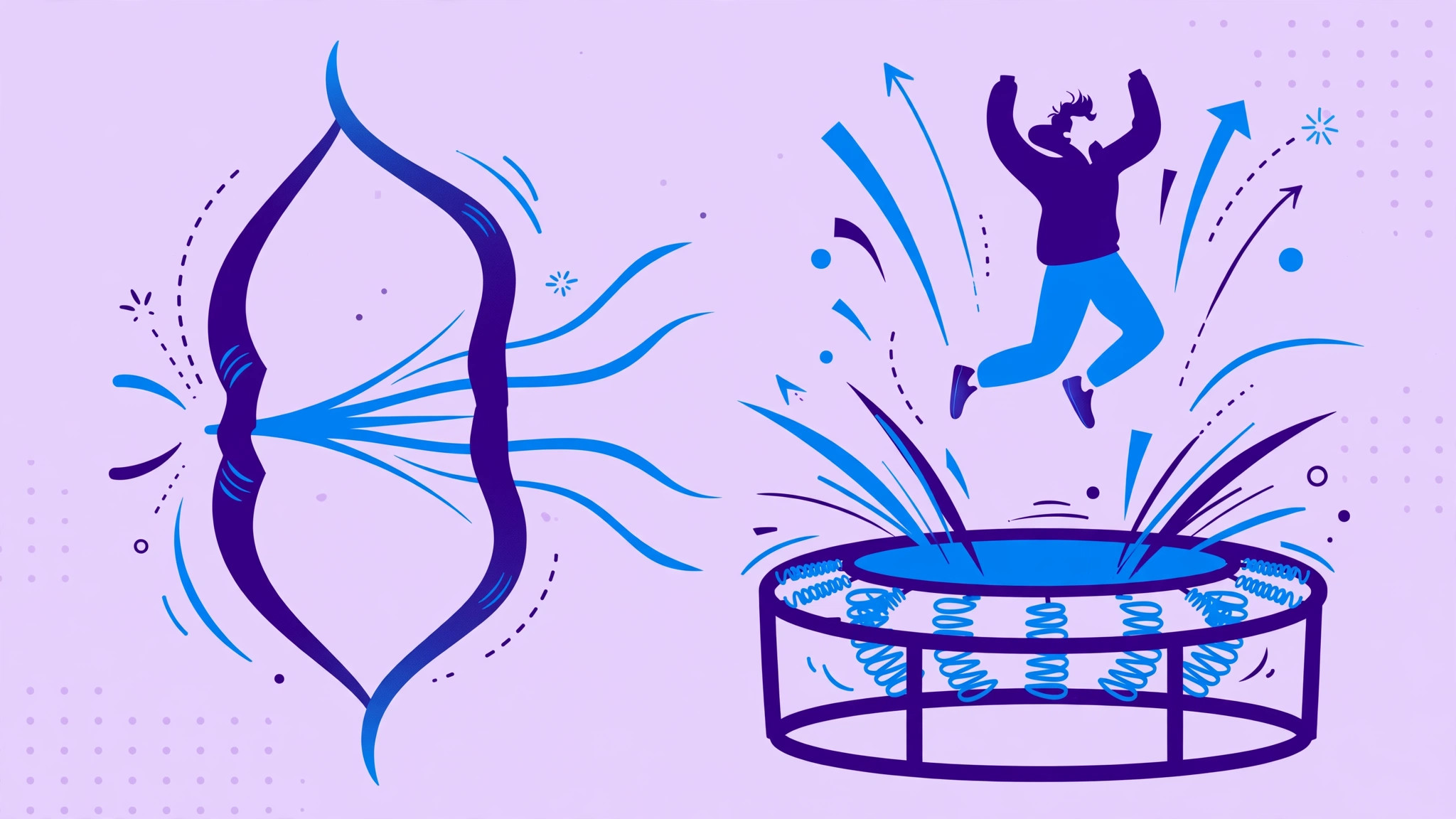
An elastic store is a battery with no chemistry: charge it by stretching or compressing, discharge it on demand. Clockwork and wind up toys run on a coiled mainspring metered out through gears. A trampoline banks the energy of a falling jumper and returns most of it, minus losses, timed by the bed's own stiffness. Archery stores the archer's slow work in bent limbs and releases it in milliseconds, a power amplification no muscle could match directly, since the release is far faster than the draw. Vehicle suspensions store the energy of bumps briefly and return it more gently, with dampers deliberately wasting a share as heat so the return does not bounce the car down the road. In each case the design questions are the same: how much energy, at what stiffness, released how fast, and what fraction is lost on the round trip.
Losses, hysteresis and honest returns
No spring returns everything. Internal friction within the material converts a slice of each cycle into heat, visible as the small loop between the loading and unloading curves on a force extension graph, an effect called hysteresis that rubber shows dramatically and steel barely at all. Repeated cycling also fatigues the material, nucleating cracks that grow until a spring fails, sometimes spectacularly, after a number of cycles its designer was supposed to count. Temperature shifts stiffness, and corrosion thins the wire where stress is highest. None of this dims the idea's usefulness; it disciplines it. A spring is the most legible energy store in physics, visible, measurable and honest about its losses, which is why it remains the right first example whenever energy storage is taught, from a click pen to the suspension of a train.
Try it: Spring Energy Calculator
A stretched or compressed spring stores elastic potential energy. Enter the spring constant and the extension or compression.
Open the calculator