Torque and Balance: The Turning Effect
Turning is force times distance
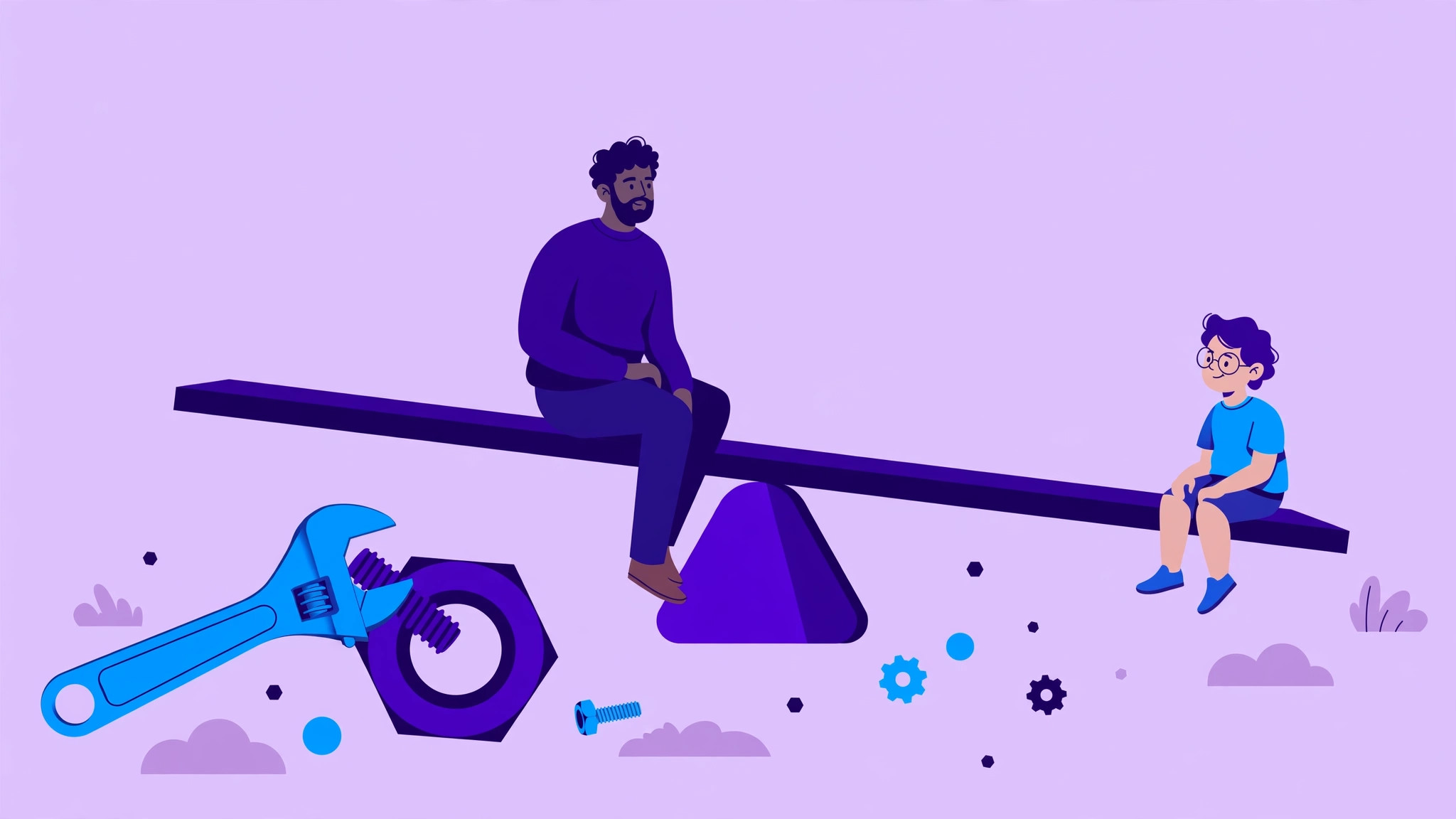
A force applied away from a pivot produces a turning effect called torque or moment, measured as force multiplied by the perpendicular distance from the pivot, and multiplied again by the sine of the angle if the force is not applied squarely. This is why door handles sit far from hinges, why long spanners free nuts that short ones cannot, and why a child can balance an adult on a seesaw by sitting further out: distance is a multiplier you can spend instead of force. The torque calculator on this site includes the angle, which is the part intuition drops: push a door at its hinge side, or along its surface instead of into it, and the turning effect shrinks toward nothing no matter how hard you push. Machines from wheelbarrows to tower cranes are arrangements for winning this multiplication where it is needed.
The principle of moments
A balanced system obeys the principle of moments: the sum of clockwise torques equals the sum of anticlockwise torques about any pivot, and nothing rotates. The rule sounds static but it governs everything from a steelyard balance to the calculations that keep a loaded crane from tipping, counterweight answering load across the tower. It also explains the body: your forearm is a lever with the elbow as pivot, the biceps attaching close to the joint, so it must pull with several times the force of the load in your hand, a poor mechanical bargain traded for speed and range of movement. Engineering and anatomy both live inside the same equation, one choosing its trade offs deliberately and the other inheriting them from evolution.
Torque beyond the seesaw
In rotating machinery torque takes centre stage: an engine's output is quoted in newton metres because torque at a given rotation speed is power, and the two figures together describe what a motor can actually do. Wrenches that click at a set torque exist because a bolt's clamping force depends on the tightening torque, and both under and over tightening fail in their own ways. Cyclists change gear to trade torque against cadence at the wheel. Even the humble screwdriver handle is fat for a reason, giving fingers a larger radius to work with. Wherever something turns, or refuses to, torque is the quantity doing the talking, and force times distance, with the angle respected, is its whole grammar.
Try it: Torque Calculator
Torque is the turning effect of a force. It grows with the force and with the distance from the pivot, and it is greatest when the force acts at a right angle.
Open the calculator