Wave Speed, Frequency and Wavelength
One line that runs the whole topic
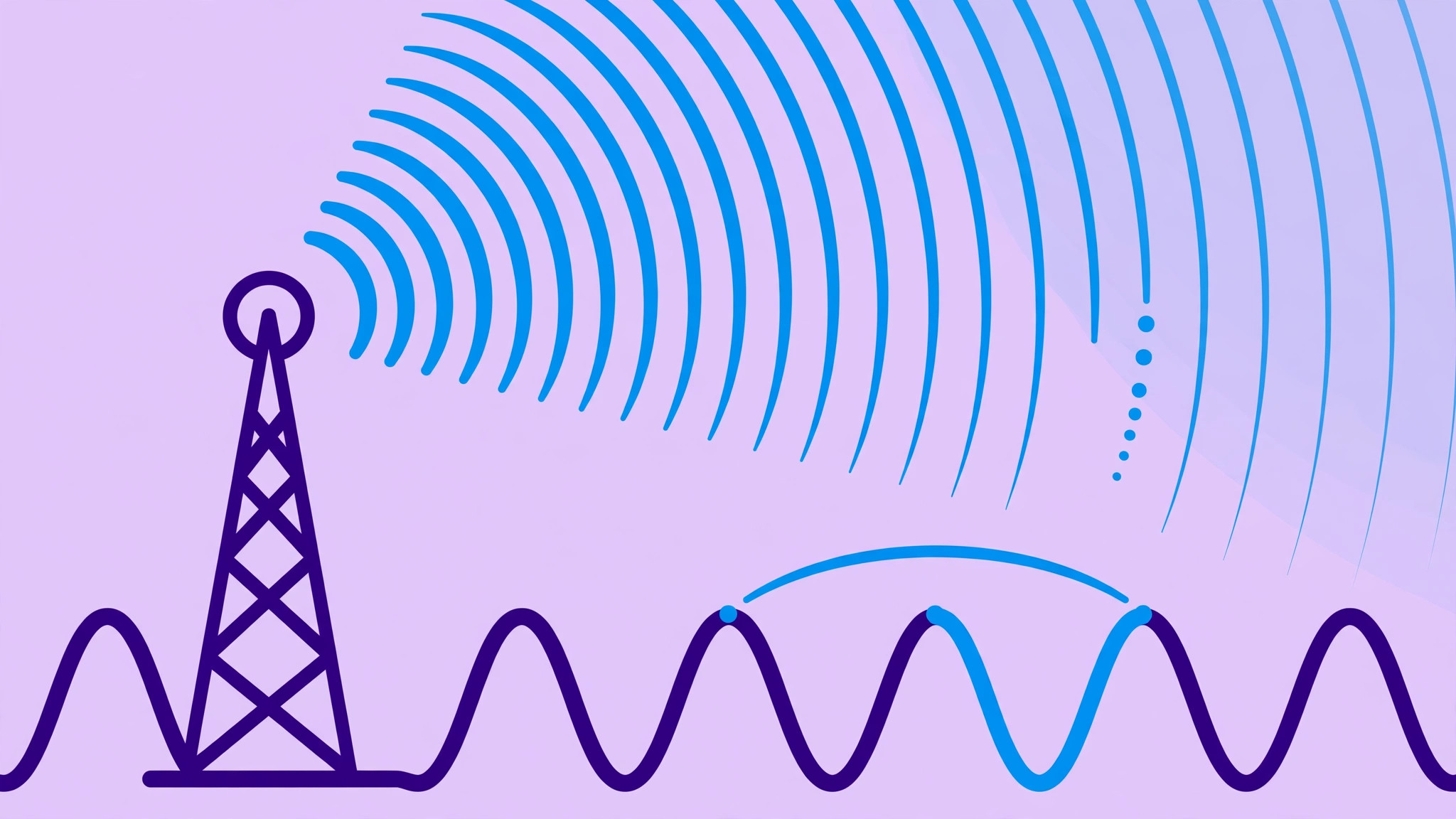
The wave equation, v = f lambda, says a wave's speed equals its frequency multiplied by its wavelength. It is less a discovery than a piece of careful counting: if f waves pass a point each second, and each wave is lambda metres long, then the wave train advances f times lambda metres per second. Yet from that counting comes the master key to every wave calculation. Radio engineers live on it, converting a station's frequency into the wavelength that sets the size of its aerials. The wave speed calculator on this site solves for any of the three quantities. Try the speed of light, 3 x 10^8 metres per second, against a radio frequency of 100 megahertz and out comes a wavelength of 3 metres, which is why car aerials are the length they are.
The speed belongs to the medium
A subtle point separates good answers from lucky ones: for sound and light alike, the speed is set by the medium, and the frequency is set by the source. When a wave crosses into a new medium, its speed changes and its wavelength adjusts so the frequency, fixed by whatever is vibrating, stays the same. Sound travels at about 343 metres per second in air at room temperature, about 1,480 in water and near 5,900 in steel, which is why a distant train is heard through the rail long before it is heard through the air. Light slows in glass and water, and the wavelength shortens in proportion, the very effect that bends it in refraction. Frequency is the traveller's identity; wavelength is its local stride, changing at every border while the count of cycles per second marches on unchanged.
Using the equation like a professional
Three habits keep wave calculations clean. First, convert frequencies to hertz and wavelengths to metres before multiplying; megahertz and centimetres are the usual ambush. Second, decide which of the three quantities the situation fixes: a medium fixes v, a source fixes f, and the third is then not yours to choose. Third, check plausibility against anchors you know: sound in air near 340, light at 3 x 10^8, human hearing from 20 hertz to 20 kilohertz, visible light wavelengths between about 400 and 700 nanometres. An answer that puts a radio wave at a wavelength of a kilometre for a gigahertz signal has slipped by six orders of magnitude somewhere, and the anchors catch it. The equation is one line; the craft is in the conversions and the checks.
Try it: Wave Speed Calculator
Every wave travels at a speed set by its frequency and wavelength. Enter any two of the three to find the one you are missing.
Open the calculator