Waves: Types, Parts and Travelling Energy
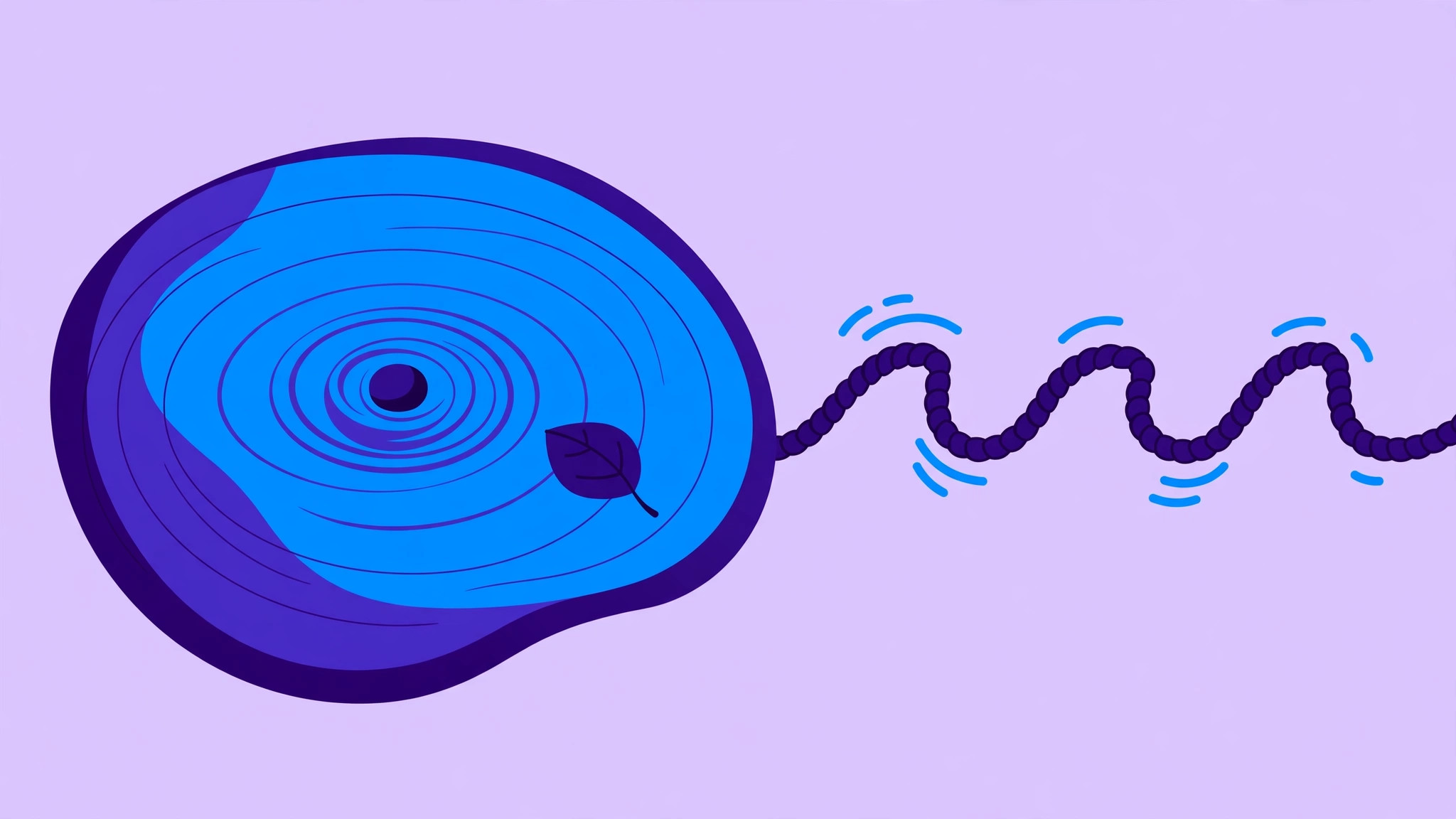
Energy on the move, matter at home
A wave is a travelling disturbance that transfers energy from place to place without transferring matter in the same direction. Throw a stone into a pond and ripples carry energy outward across the surface, while a floating leaf near the splash mostly bobs in place. That distinction, energy travels, medium oscillates, is the single most important idea in wave physics, and it explains how a voice crosses a room without a wind, how sunlight crosses empty space, and how an earthquake in one continent registers on instruments in another. Every wave has a source that vibrates and a medium, or in light's exceptional case a field, that passes the vibration along, each part nudging the next and then returning toward where it started.
Two families: transverse and longitudinal
In a transverse wave the oscillation runs at right angles to the travel direction: ripples on water, waves on a rope, and all electromagnetic waves, light included. Peaks are crests and valleys are troughs. In a longitudinal wave the oscillation runs along the travel direction, as compressions and rarefactions: sound is the standard example, a speaker cone pushing air molecules into crowded and thinned bands that march across the room. Some waves mix both, as ocean waves do, moving surface water in small circles. The anatomy shared by both families is a short vocabulary worth owning: wavelength, the distance between matching points on neighbouring cycles; amplitude, the maximum displacement from rest, which carries the energy story; frequency, the cycles per second; and period, the seconds per cycle.
Why the vocabulary pays
With those four quantities defined, one equation governs the whole subject, v = f lambda, the subject of the next guide and of the wave speed calculator on this site. The vocabulary also separates questions that sound similar. Pitch is frequency, loudness is amplitude, and the speed of sound in air is set by the air, not by the shout. A wave's energy grows with the square of its amplitude in most systems, which is why a doubling of earthquake magnitude scales means something far more violent than a doubling of shaking. Learn to ask of any wave: what is oscillating, which family is it, and what are its wavelength, frequency and amplitude, and you have the framework that optics, acoustics, radio and seismology all build on.
Try it: Wave Speed Calculator
Every wave travels at a speed set by its frequency and wavelength. Enter any two of the three to find the one you are missing.
Open the calculator